MVP Software Development Company SOW: What to Lock Before You Sign
A fixed-price SOW checklist for founders choosing an MVP software development company: scope, exclusions, acceptance criteria, handoff, and change control.

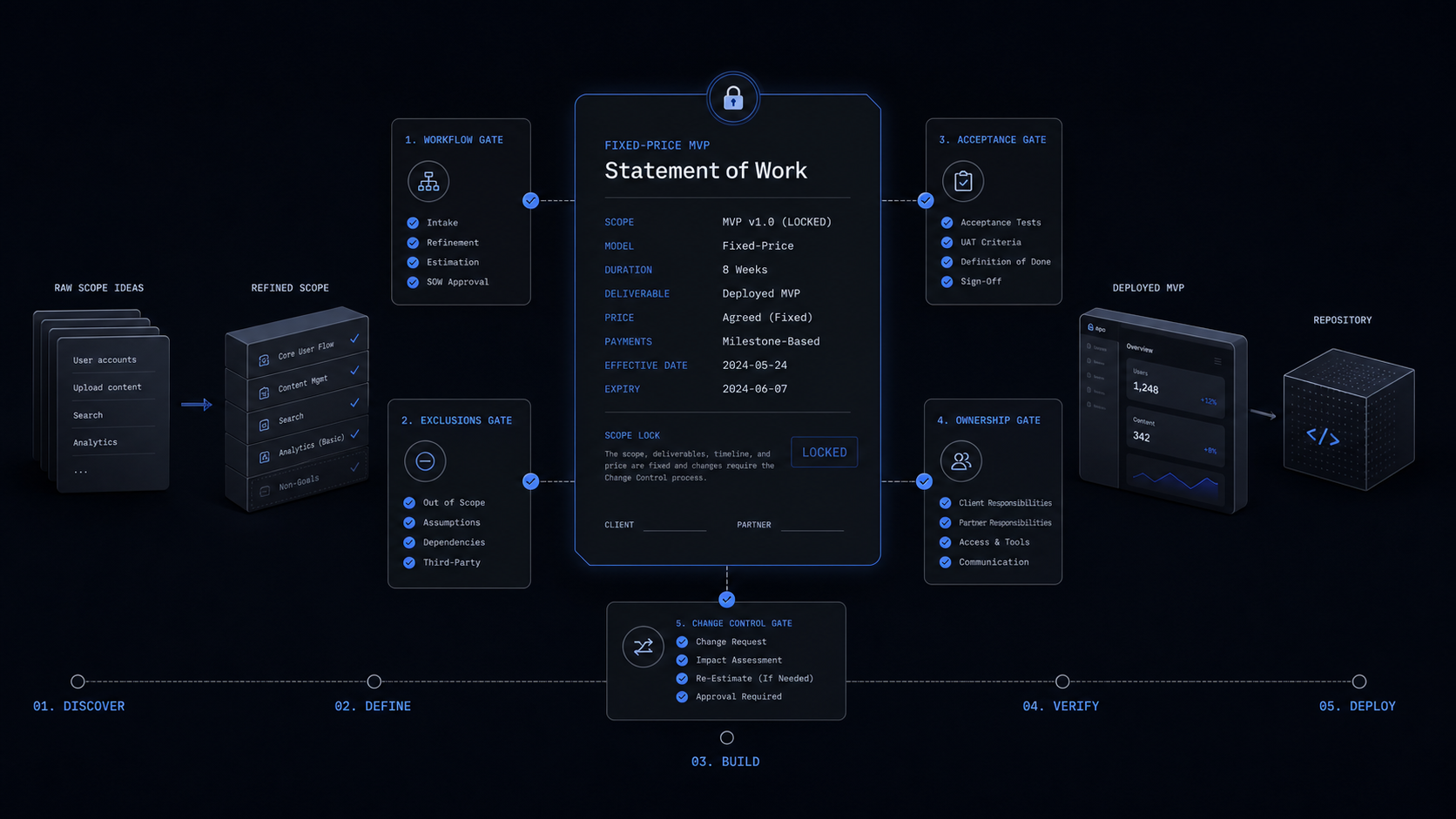
The right MVP software development company will put the scope in writing before it sells the build. If the statement of work does not name the workflow, exclusions, acceptance criteria, ownership, and change process, the fixed price is not fixed.
The SOW Is The Product Before The Product
A funded founder should judge an MVP company by the statement of work before judging the mockups. A statement of work, or SOW, is the project document that defines activities, deliverables, timelines, requirements, pricing, and terms. For an MVP, it is the contract version of the product strategy.
An MVP is the smallest serious version that proves one core workflow with real users. ScienceSoft's service page describes MVP software as a fully functional solution with just enough functionality to release to the market. That is the right bar: not a clickable prototype, not a full platform, and not a vague promise to "iterate."
The SOW should make the first product boringly concrete. It should say who logs in, what they do, what data is saved, what payment or approval happens, what success looks like, what is not included, and what the founder owns after launch. If those answers live in sales calls but not the SOW, the project is still discovery dressed as delivery.
Use the SOW as your first product test. If the company cannot reduce the idea to one controlled workflow on paper, it will not become clearer once designers, engineers, integrations, and invoices are moving.
Use One Core Workflow As The Boundary
The fixed-price boundary should be one core workflow, not one giant feature list. A workflow is the repeatable path where a user creates value: submit a request, review it, approve it, pay for it, export it, or receive the result.
For a B2B approvals MVP, the core workflow might be: a requester creates a proposal, a reviewer approves or rejects it, and an admin can see the status. That is enough to test whether the customer has a real operational pain. The tempting extras are obvious: analytics, team permissions, templates, comments, email digests, Slack alerts, and a polished reporting suite. Some may matter later. They do not all belong in the first fixed-price scope.
Name the user job
Write the job in one sentence: "A customer success lead needs to approve renewal discounts before sales sends a quote." If the sentence needs several unrelated verbs, split the scope.
Name the start and finish
The workflow starts when the user creates the request and ends when the request is approved, rejected, paid, exported, or delivered. Everything outside that path is a candidate for later.
Name the proof
The MVP is proven when a real user completes the workflow without a manual workaround that hides the product's main risk.
This is also where the company should tell you what it will cut. A senior MVP partner should be comfortable saying that a second persona, a complex dashboard, or a speculative integration is not version one. Scope control is not a lack of ambition. It is how the first shipped product stays usable, ownable, and testable.
The Fixed-Price SOW Must Name Five Things
A fixed-price MVP SOW is credible when it names the included workflow, the exclusions, the acceptance criteria, the handoff, and the change process. Without those pieces, the price can stay fixed only by quietly reducing quality, arguing over interpretation, or pushing essential work into a later bill.
The acceptance criteria are where vague MVP language becomes a buildable product. "Payments are included" is not enough. A better criterion is: a logged-in customer can choose a plan, complete checkout, return to the app, and see the active subscription state. That still leaves implementation choices open, but it tells both sides what must work.
The exclusions matter just as much. If investor reporting, native mobile apps, multi-region deployment, enterprise SSO, custom permissions, and advanced admin tooling are not in scope, the SOW should say so. A short exclusion list is not negative. It protects the product from becoming a half-built platform before anyone has used the first workflow.
This is where our MVP company vetting checklist pairs with the SOW. Vet the partner first, then make the scope enforceable before the build starts.
Price The Company By Delivery Shape, Not Hourly Rate
Hourly rate is a weak proxy for MVP risk. Directories are useful for market scanning, but they do not tell you whether a company can hold scope, ship cleanly, and hand over an owned product.
The current DesignRush MVP development directory lists 465 companies, says its rankings were updated June 30, 2026, and notes that some listings may be paid. Its visible sample listings include hourly rates such as $20/hr, $50/hr, $149/hr, $35/hr, $40/hr, $80/hr, $87/hr, and $100/hr, plus minimum budgets from under $1,000 to $50,000. S-PRO's directory lists 22 MVP development companies with bands including $25-$49, $20-$99, $50-$99, and $100-$149.
Those ranges prove the market is broad. They do not prove the scope is safe. A cheap hourly team can become expensive if the product owner has to write the missing product spec, manage QA, define acceptance tests, and rebuild the handoff. A premium team can still be wrong if it sells a large roadmap instead of a version-one workflow.
Price the shape of delivery instead:
- A fixed scope that names the workflow and exclusions.
- A senior owner who can make product cuts before engineering starts.
- A working app with real auth, data persistence, payments or the core transaction, deployment, and QA.
- A handoff package that makes the code and accounts yours.
- A change process that keeps new ideas from breaking the fixed price.
The useful question is not "What is your hourly rate?" It is "What exact product will exist at the end, how will we know it is done, and what happens when we ask for something outside the scope?"
Demand Ownership And Handoff Before Build Starts
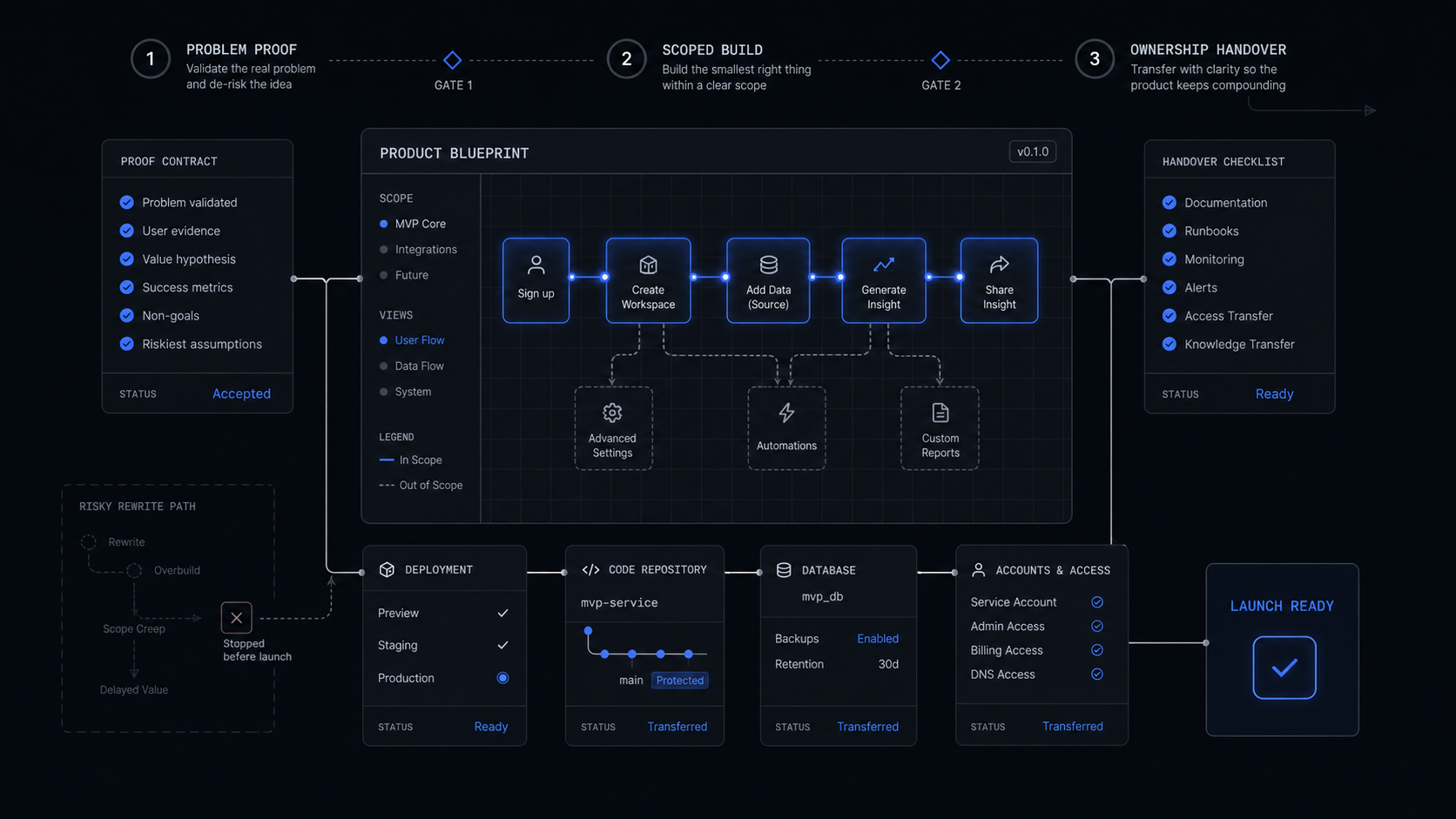
Ownership is not a final-week admin task. It is part of the scope. The SOW should say where the repository lives, who controls production accounts, how environment variables are transferred, what documentation is delivered, and what support is included after launch.
ScienceSoft's own MVP service page names coding, quality assurance, security configuration, and deployment as part of MVP development, and names monitoring, troubleshooting, CI/CD pipelines, and cloud resource optimization as post-launch concerns. That is the right reminder for buyers: an MVP is not just screens. It is the product system that lets those screens survive real users.
For a fixed-price SaaS MVP, the handoff should include:
- Source code in a repository the founder or company controls.
- Deployment access and a clear production environment.
- A list of third-party services, billing owners, and renewal risk.
- Basic run instructions for local setup and production release.
- A known bug list and a short warranty or support window.
- Admin credentials transferred through a secure process, not pasted into chat.
If a company resists this conversation before signing, treat that as a scope risk. The cost of ownership ambiguity usually appears later, when the next engineer needs to debug billing, the founder needs diligence-ready code access, or a growth experiment depends on a small product change.
For a broader view of what belongs in the first serious build, use the fixed-price SaaS MVP scope as the companion checklist.
What To Cut From Version One
The best MVP SOW is as clear about cuts as it is about features. Cut anything that does not prove the core workflow, reduce launch risk, or make the product safe enough for real users.
Cut speculative dashboards until the team knows which decisions users actually make. Cut multi-role permission systems unless permissions are the product risk. Cut native mobile if a responsive web app can prove the workflow. Cut custom billing logic if a standard checkout flow can prove willingness to pay. Cut integrations that can be handled by import, export, or a manual back-office step during the first release.
This does not mean shipping a toy. Keep the parts that protect the product: authentication, data integrity, payment or transaction logic, basic admin visibility, deployment, QA, and ownership. Cut the parts that make the first build feel bigger without making the first customer more successful.
The SOW should make those tradeoffs visible. A founder should be able to read it and say, "This version will prove the workflow, and these are the things we are intentionally not buying yet."
What should be included in an MVP software development SOW?
The SOW should include the core workflow, deliverables, exclusions, acceptance criteria, timeline, price, ownership terms, support window, and change process. If a feature is important enough to affect cost or launch risk, it belongs in writing.
Is a fixed-price MVP better than hourly development?
Fixed price is better when the workflow is narrow enough to define and test before work starts. Hourly development is safer when discovery is still open, the product requires ongoing experimentation, or the buyer is not ready to choose version-one cuts.
How do I know if an MVP company is over-scoping the project?
The scope is too large when the first release has several unrelated workflows, speculative integrations, complex permissions, heavy reporting, and no measurable acceptance criteria. A strong MVP company will cut those pieces before asking you to sign.
Scope Your MVP
Turn the first product workflow into a fixed-price build with clear scope, handoff, and ownership from day one.
Jul 1, 2026