MVP Development Company: How to Pick One Without Buying a Rewrite
A founder-grade checklist for choosing an MVP development company, locking scope, and shipping a fixed-price SaaS MVP you can own after launch.

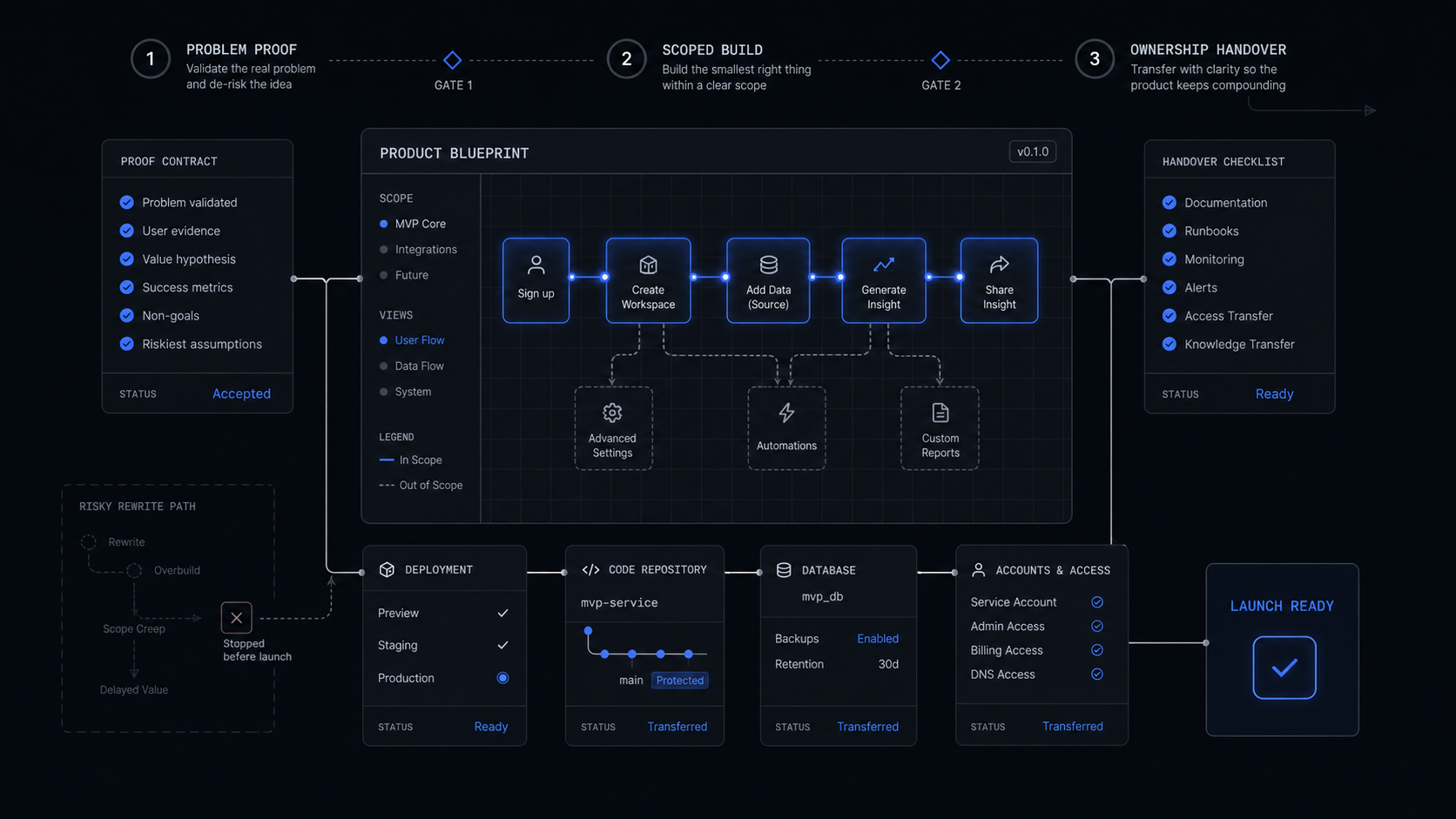
The right MVP development company does not start by promising more features. It proves which one workflow deserves to ship, writes down what is out of scope, and hands you a product your next team can actually own.
The best MVP company is a scope-control company
An MVP development company is worth hiring when the main risk is not "can we make a demo?" but "can we launch the smallest real product without creating a rewrite bill?" For a funded SaaS founder, the job is to turn uncertainty into a scoped build: one core workflow, real users, real auth, real data, real payment or activation path, and clean ownership after launch.
That matters because startup failure is rarely caused by missing extra features. CB Insights analyzed 431 VC-backed companies that shut down since 2023 and found that, among the 385 companies with identifiable reasons, 70% ran out of capital, 43% had poor product-market fit, 29% were hit by bad timing, and 19% had unsustainable unit economics (CB Insights). Your first build should reduce those risks, not bury them under a long backlog.
The practical test is simple: if the company cannot describe what the first version will not include, it is not ready to build your MVP. A strong partner should be able to say:
- This is the user role we are serving first.
- This is the single workflow that proves value.
- This is the data the workflow must create.
- This is the payment, invite, or activation event that counts as a real signal.
- These are the features we are intentionally leaving for later.
Y Combinator's Michael Seibel gives founders the same operating principle from the product side: talk to users, launch quickly, and hold the problem and customer tightly while holding the solution loosely (YC). That is the difference between an MVP company and a software vendor. The vendor asks for a feature list. The MVP company asks what must be true after launch for the next build decision to be obvious.
Use this decision rule before you shortlist agencies
Hire an MVP development company when your first version must survive real customers, not when you only need a clickable story. AI builders, internal engineers, freelancers, and agencies can all produce something that looks like a product. The buying decision is about what happens when users sign in, pay, invite teammates, enter data, hit an error, and ask for handover.
Use this rule before any shortlist:
The rewrite risk usually appears before the contract is signed. It appears when the company says yes to every feature, treats the launch site as separate from the product journey, or refuses to name the stack and deployment model. It also appears when the estimate is based on screens instead of workflow states. A small dashboard can be cheap or expensive depending on roles, permissions, audit history, billing, data imports, and failure modes.
For a SaaS MVP, the first question is not "how many screens?" It is "what job does the user complete without a human holding the system together?" If that job is onboarding a client, the MVP might need signup, a guided form, file upload, admin review, email notification, payment, and status tracking. If that job is generating a report, the MVP might need source upload, validation, a processing queue, results view, export, and basic billing. Scope the workflow, then design the screens.
If your first concern is whether AI build tools can carry the product far enough, read our guide to fixed-price MVP scope before you buy development time. If you already have an AI-coded prototype, the decision is whether to keep building on it or convert it into owned production software.
What must be in scope before you sign
A serious MVP scope should read like an operating agreement for the first version. It does not need to be huge, but it must be specific enough that both sides can tell when the build is done.
The minimum signed scope should include:
- Target user and trigger: who starts the workflow, and what event makes them start.
- Core workflow: the one user path that proves the product.
- User roles: founder admin, customer user, teammate, reviewer, or any other role that changes permissions.
- Data model: the main objects the product stores and who can create, edit, delete, or export them.
- Integrations: payments, auth, email, storage, analytics, AI model calls, CRM, or internal systems.
- Launch site boundary: what the public site must explain, capture, and route into the product.
- Quality bar: browser coverage, device coverage, seed data, error states, and manual QA pass.
- Deployment: hosting account, environment variables, domain, database, storage, and rollback path.
- Analytics: the few events that prove whether users complete the workflow.
- Handover: repo ownership, credentials inventory, architecture notes, known limitations, and next-scope recommendations.
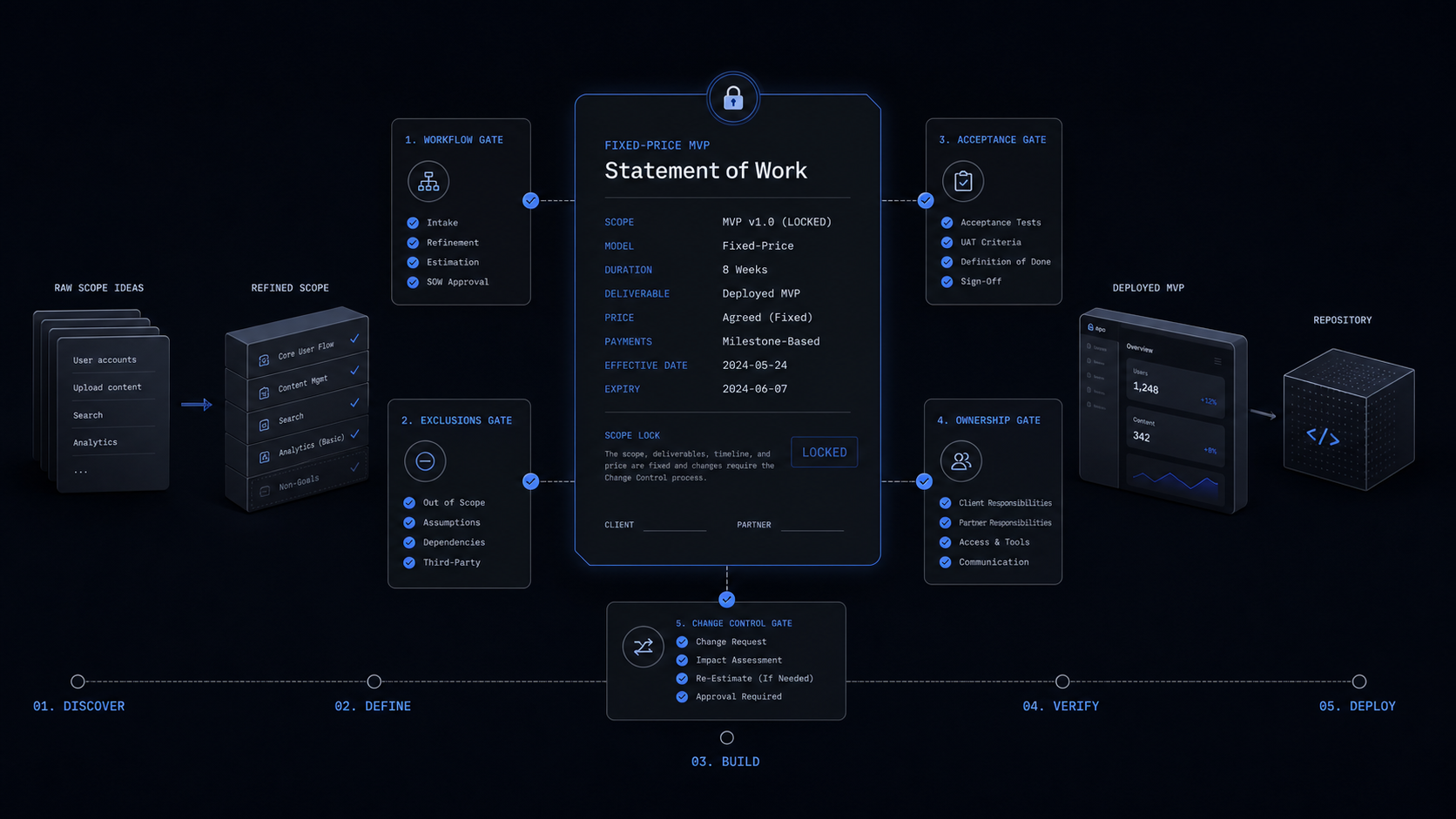
This is where a fixed-price MVP is won or lost. The company should not ask you to sign a feature cloud. It should convert the feature cloud into a scope ledger: included, excluded, deferred, or decision-needed.
Name the workflow
Write the workflow in one sentence: "A hiring manager uploads a job description, reviews AI-ranked candidates, invites a shortlist for screening, and pays for the result." If the sentence needs commas forever, the MVP is too broad.
Name the proof event
Pick the event that tells you the workflow mattered. Examples: a buyer pays, a user invites a teammate, an operator completes a review, or a customer exports a result. Do not use "user created an account" as the proof event unless signup itself is the product.
Name the exclusions
Write the features that sound useful but do not prove the workflow. Examples: advanced roles, team billing, native mobile apps, multilingual content, complex admin analytics, or custom notification preferences.
Name the owner after launch
The repo, database, domain, deployment project, payment account, and analytics account should sit under the founder's control or a clean client-owned workspace. Handover should not depend on a vendor account you cannot inspect.
YC's MVP guidance is useful here because it is brutally practical: a lean MVP should be buildable in weeks, not months, and founders should timebox the spec, write the spec, and cut the spec when the deadline is at risk (YC). A good MVP company helps you do that without losing the product's spine.
A reference scope for a first SaaS MVP
For a business workflow product, a sane first paid scope might look like this:
That table is not small because ambition is small. It is small because learning is the point. The next build should be funded by evidence from users, not by fear that the first version might look incomplete.
The stack should be boring where trust matters
The first stack should use proven services for trust-heavy basics and custom code for the part that makes the product different. Founders often waste scope on building login, billing, storage, deployment, and admin plumbing from scratch. That is usually the wrong place to spend the first budget.
A practical SaaS MVP stack might use:
These numbers are not the whole budget. They are reference points for what should not become a custom engineering project in the first version. If an MVP estimate spends serious time rebuilding commodity infrastructure, ask why. Sometimes there is a good reason: compliance, enterprise procurement, private hosting, or an existing system constraint. Most early SaaS products do not have that reason yet.
The custom part should be the product workflow: the thing the user pays for, returns to, or recommends. That is where the company should show product judgment. For example, an AI reporting MVP should spend more effort on upload validation, prompt boundaries, result review, regeneration, and export quality than on a custom login screen. A marketplace MVP should spend more effort on supply quality, trust rules, and transaction state than on a complex notification center.
Red flags that predict a rewrite
The strongest red flags are not ugly portfolios. They are soft commitments around scope, ownership, and production behavior.
Directory pages can help you build an initial vendor list, but they are not a decision system. DesignRush listed 462 companies for MVP development on a page updated June 24, 2026, and discloses that some listings may be paid (DesignRush). S-PRO's directory lists 22 MVP development companies, with sample hourly ranges such as $25 to $49, $20 to $99, and $25 to $49 across different firms, and team sizes from 50 to 249, 250 to 999, and 1,000 to 9,999 employees (S-PRO). Those facts are useful for market shape. They do not tell you who will preserve your scope.
Watch for these rewrite signals:
- The estimate is screen-based. Screens matter, but workflow states matter more. Ask what happens after a failed payment, a duplicate upload, a deleted user, or an incomplete AI result.
- The company avoids exclusions. Fixed price without exclusions is not fixed scope.
- The handover is described as "we give you the code." Code is not enough. You need deployment notes, environment setup, account ownership, secrets inventory, architecture notes, and known limitations.
- The portfolio is all logos and no product detail. Logos prove sales history, not MVP judgment.
- AI is treated as a shortcut around product work. AI can speed up implementation and exploration, but it does not remove the need for scope, QA, data boundaries, logs, and handover.
- The launch site is scoped as decoration. For most early SaaS products, the launch site is part of the product funnel. It must explain the offer, qualify the buyer, route the activation path, and support AI/search discovery.
The cleanest question to ask is: "What would make you refuse to build this feature in the first version?" A senior MVP company should have an answer. It should defend the launch goal, not just protect its margin.
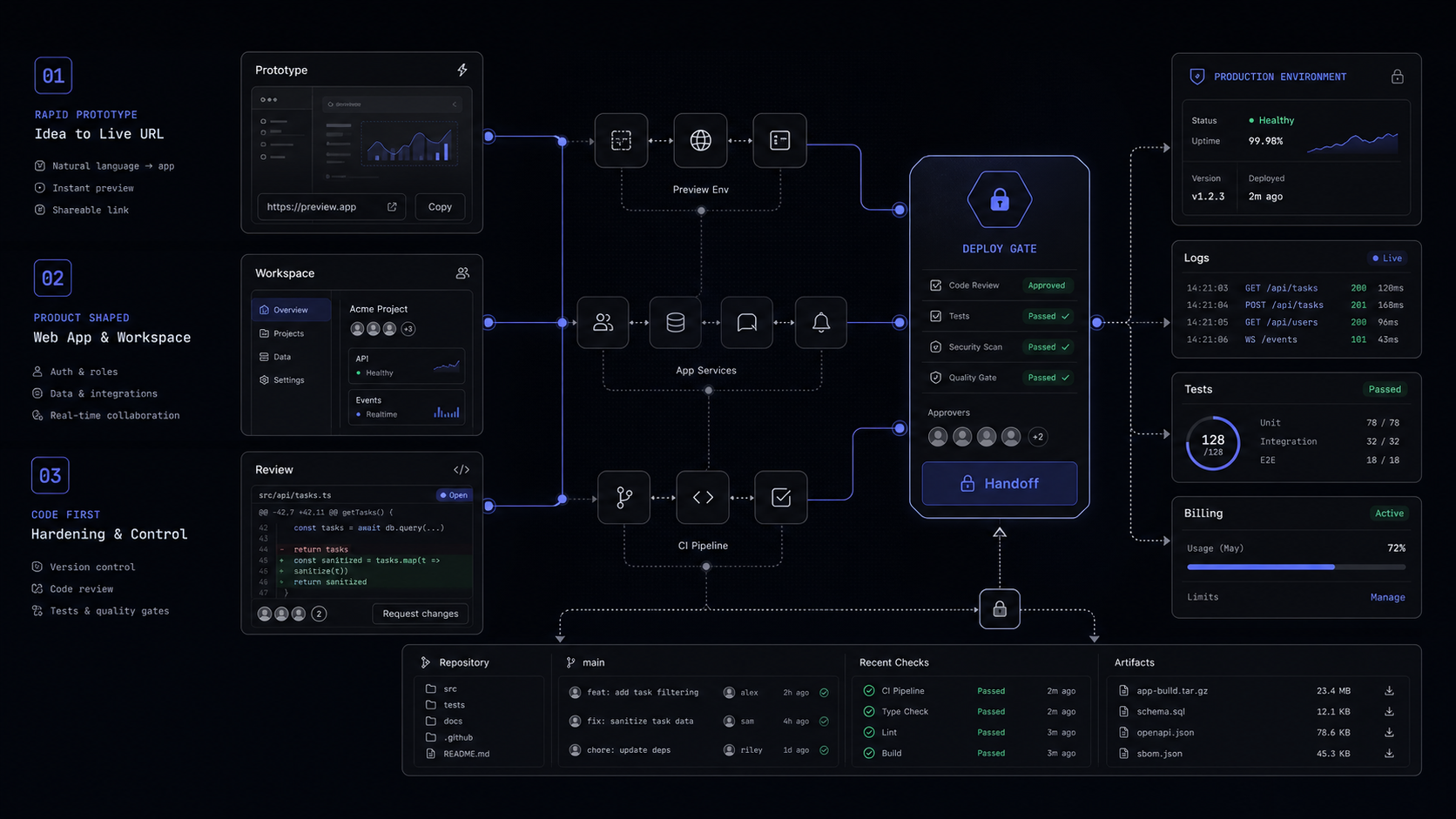
If you have an AI-generated prototype already, the risk is different. The prototype may be useful, but the company should inspect whether it can be productionized. Our guide to AI coding tool handoff risks covers that decision in more depth. For this buying decision, the key question is whether the company can turn the prototype into a durable owned product without carrying forward fragile structure.
A contract-ready checklist
Use this checklist before you sign a paid MVP build. A company does not need perfect answers in the first call, but it should be willing to answer each item before work begins.
The contract should also name what happens after launch. A fixed-price MVP can include a short bug-fix window, a paid support option, or a scoped next sprint. What it should not include is an implied forever roadmap. That is how founders lose the clarity they paid for.
The founder email to send before a proposal
Copy this into your shortlist process:
We are evaluating an MVP development company for a fixed-scope SaaS build. Please respond with the single workflow you would recommend for v1, the features you would exclude, your preferred stack for auth, payments, database, hosting, analytics, and AI if relevant, how source-code and deployment ownership work, what QA is included, and what handover documents we receive after launch.
The best replies will be specific and a little opinionated. The weak replies will ask for a full feature list, promise to build everything, or push you into a discovery call without showing how they think.
The verdict
Choose the MVP development company that protects the first version from bloat and protects the second version from a rewrite. That means fixed scope, explicit exclusions, boring infrastructure, production-quality handover, and one workflow that real users can complete.
Do not hire the biggest directory listing by default. Do not hire the cheapest hourly rate by default. Do not hire the team that agrees with every feature. Hire the team that can say: this is the smallest version worth owning, this is what we will not build yet, and this is how your next team can continue after launch.
What is MVP development?
MVP development is building the smallest product that lets real users complete the core workflow and give useful feedback. It is not a mini version of the whole roadmap; it is the first owned product you can learn from.
What should MVP development services include?
MVP development services should include product scope, UX for the core workflow, production development, deployment, QA, analytics, and handover. If ownership, deployment, and exclusions are missing, the scope is not ready.
Is MVP development for startups different from normal software development?
Yes. Startup MVP work optimizes for speed, learning, and code ownership, while normal software development often starts from a broader feature roadmap. The first version should prove a market-facing workflow before the build expands.
Should I hire an MVP development company or use an AI builder?
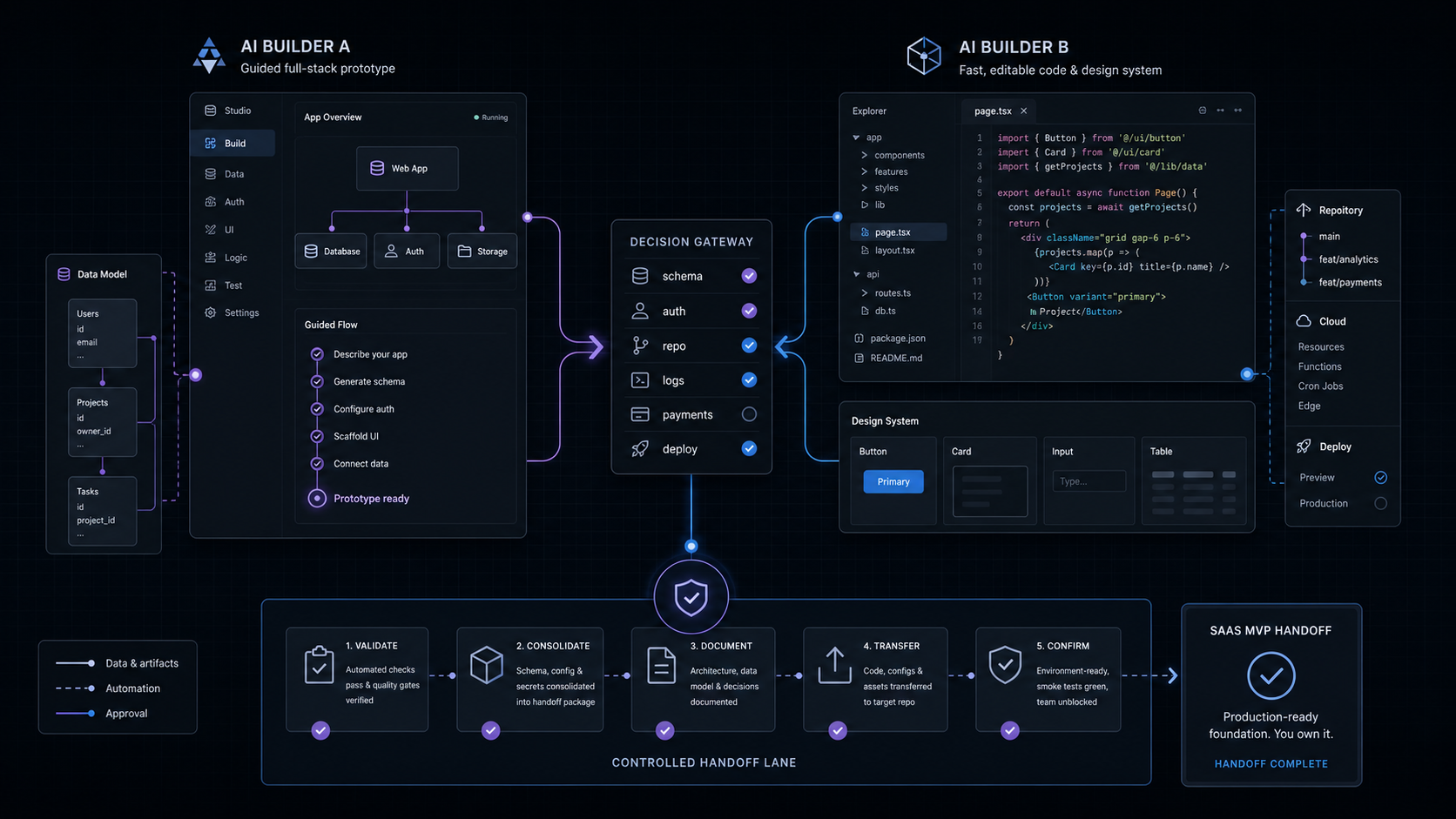
Use an AI builder for prototypes, demos, and internal exploration. Hire an MVP development company when users, payments, auth, data, launch quality, and handover need to work under your ownership.
Scope Your MVP
Turn your SaaS idea into a fixed-scope MVP with the core workflow, launch path, and handover defined before the build starts.
Jun 24, 2026