AI SaaS MVP Development Services: What Fixed-Price Builds Should Include
Scope a fixed-price AI SaaS MVP around one core workflow, auth, payments, dashboard, AI logs, and the version-one features to skip.

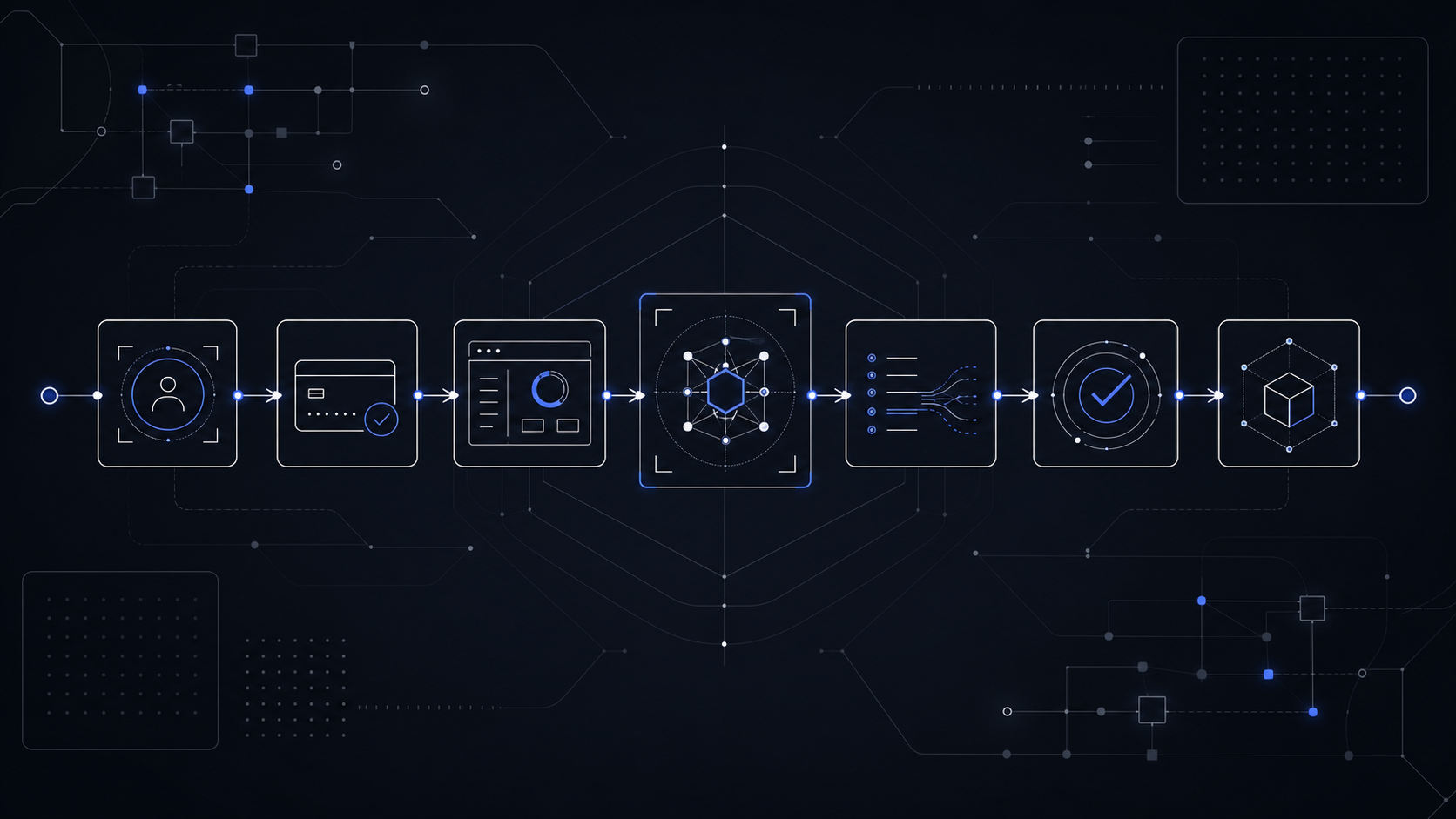
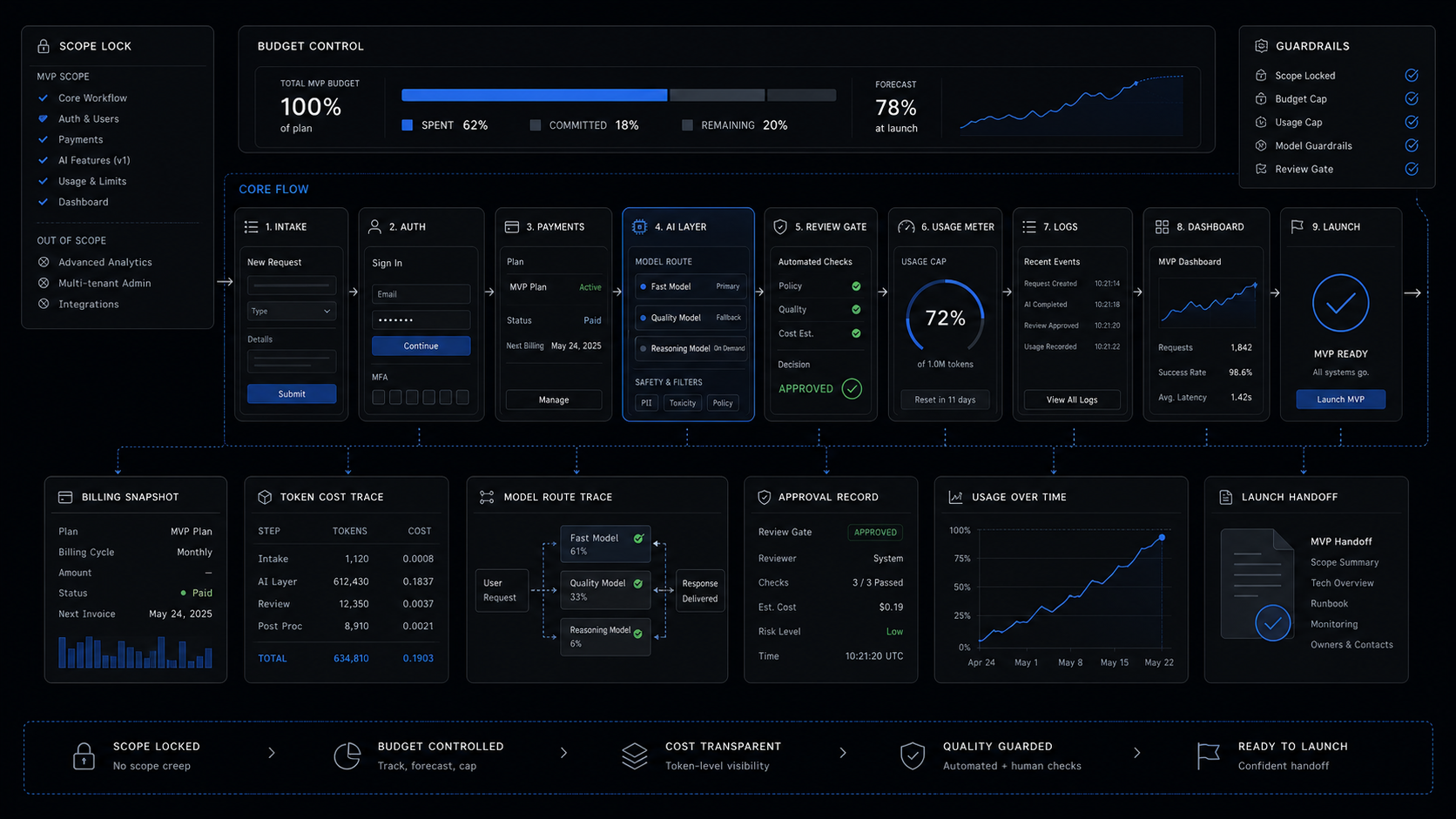
A fixed-price AI SaaS MVP should prove one paid workflow, not assemble a small version of the whole company. The right scope is auth, payments, one dashboard, one AI layer, logs, and a handoff path, with every extra integration forced to earn its place.
The Short Verdict
AI SaaS MVP development services are worth buying when they turn a product bet into a working, ownable system with a fixed boundary. A SaaS MVP is a minimum viable product, the smallest product that can test whether customers will use and pay for the core workflow. For an AI SaaS product, the MVP has one extra obligation: it must prove that the AI layer improves the workflow enough to justify its cost, latency, and risk controls.
The useful version-one scope is smaller than most founders expect:
- One customer segment.
- One core workflow.
- One paid plan or checkout path.
- One dashboard for the user or operator.
- One AI layer with logging, fallback, and review controls.
- One production deployment with documented environment variables, model settings, and handoff notes.
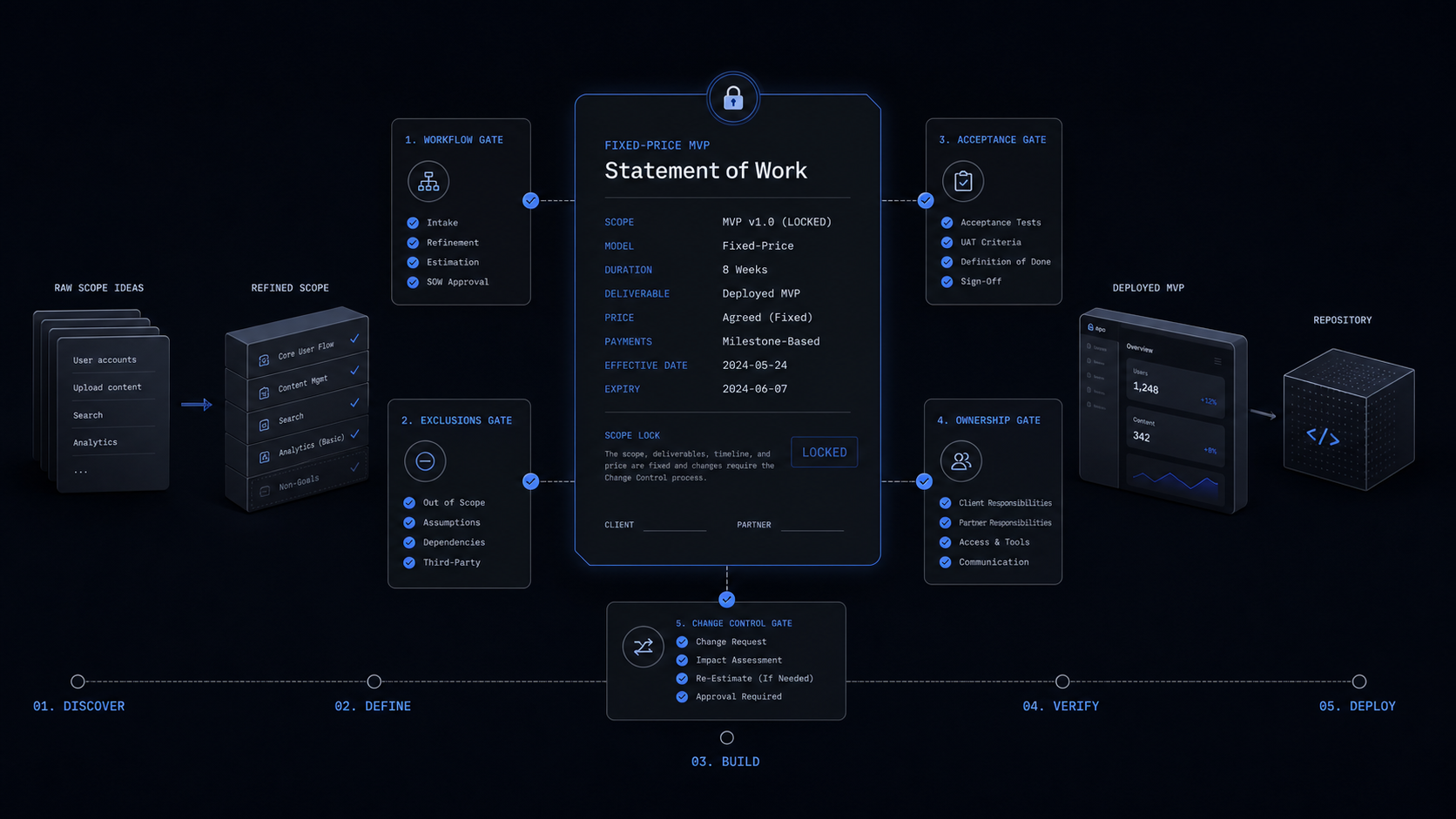
That is enough to test a real business. It is not enough to satisfy every future customer, every sales request, or every edge case. That is the point. A fixed-price MVP only works when the build team can say no to the features that would turn the first release into a half-built platform.
The scope should not start with "build an AI agent." It should start with the job the customer is trying to finish. If the job is simple retrieval, an assistant is enough. If the job is repeatable routing, automation may be better. If the job requires decisions across multiple steps, an agent can be worth scoping, but only with logs, approvals, and bounded actions. Gartner's 2025 agentic AI warning is the right backdrop here: it predicted that over 40% of agentic AI projects would be canceled by the end of 2027 because of escalating costs, unclear business value, or inadequate risk controls. The MVP should be designed against those failure modes from day one.
The One-Core-Workflow Rule
The first version should make one workflow valuable enough that a customer would repeat it. Everything else is support structure.
For a founder, the most useful test is not "can we build the product?" A competent studio can build screens, prompts, accounts, and payments. The useful test is "does one painful workflow become faster, clearer, or cheaper when the customer uses this product instead of their current process?"
Here is the difference:
The fixed-scope version has a clear input, a transformation, an output, a human decision point, and a success measure. That is what makes it buildable on a fixed price. The broad version is a product strategy conversation disguised as a build request.
The AI layer should be chosen after the workflow is locked. A simple assistant is a chat or retrieval interface that helps the user find or draft something. An automation is a deterministic workflow, usually triggered by an event, that moves data and applies rules. An agent is a system that can decide between actions inside a bounded process. If that choice is still unclear, the safer starting point is the assistant-versus-agent decision rule in AI Assistant vs AI Agent: Which Should You Build First?.
Gartner's recommendation lines up with this scope discipline: use agents when decisions are needed, automation for routine workflows, and assistants for simple retrieval. That is not a vocabulary exercise. It is a budget control. A retrieval assistant, a workflow automation, and a multi-step agent do not carry the same testing burden, token spend, or operational risk.
Name the paid workflow
Write the workflow as "user does X, the system produces Y, the buyer values Z." If the sentence needs three personas and five exceptions, the MVP is too wide.
Pick the AI role
Choose assistant, automation, or bounded agent based on the decision burden. Do not use an agent when a deterministic rule or retrieval answer is enough.
Define the inspection point
Decide where the founder, admin, or customer can inspect the AI output before it matters. For version one, logs and review states are product features, not internal tooling.
Cut the second workflow
Move every adjacent workflow into a post-MVP backlog. A fixed-price build needs a real "not now" list, or the scope will leak.
The Fixed-Scope Build Checklist
A useful AI SaaS MVP includes the product surface, the operating controls, and the handoff materials. Leaving out the controls makes the demo cheaper and the product harder to trust.
The baseline checklist is:
The most important row is controls. AI SaaS products fail quietly when the founder cannot answer basic operating questions:
- Which model was called?
- What prompt or workflow version produced the output?
- What did it cost?
- Did the user accept, edit, retry, or ignore the output?
- Which failures need manual review?
- What happens when the model returns low confidence, times out, or violates a rule?
Those questions should be visible in the MVP. They do not require a huge analytics system. They require a simple log table, an admin screen, and a habit of saving the right events.
For example, a document-review SaaS MVP does not need team folders, clause libraries, redlining collaboration, and enterprise procurement workflows. Version one can be:
- Upload one document type.
- Extract key terms into a structured table.
- Highlight risky clauses with a short explanation.
- Let the user approve, edit, or reject each finding.
- Save every model call, prompt version, output, user decision, and cost estimate.
- Export a clean report.
That is a product a founder can sell, demo, and learn from. It is also a system a build partner can scope.
The Stack Baseline And Cost Controls
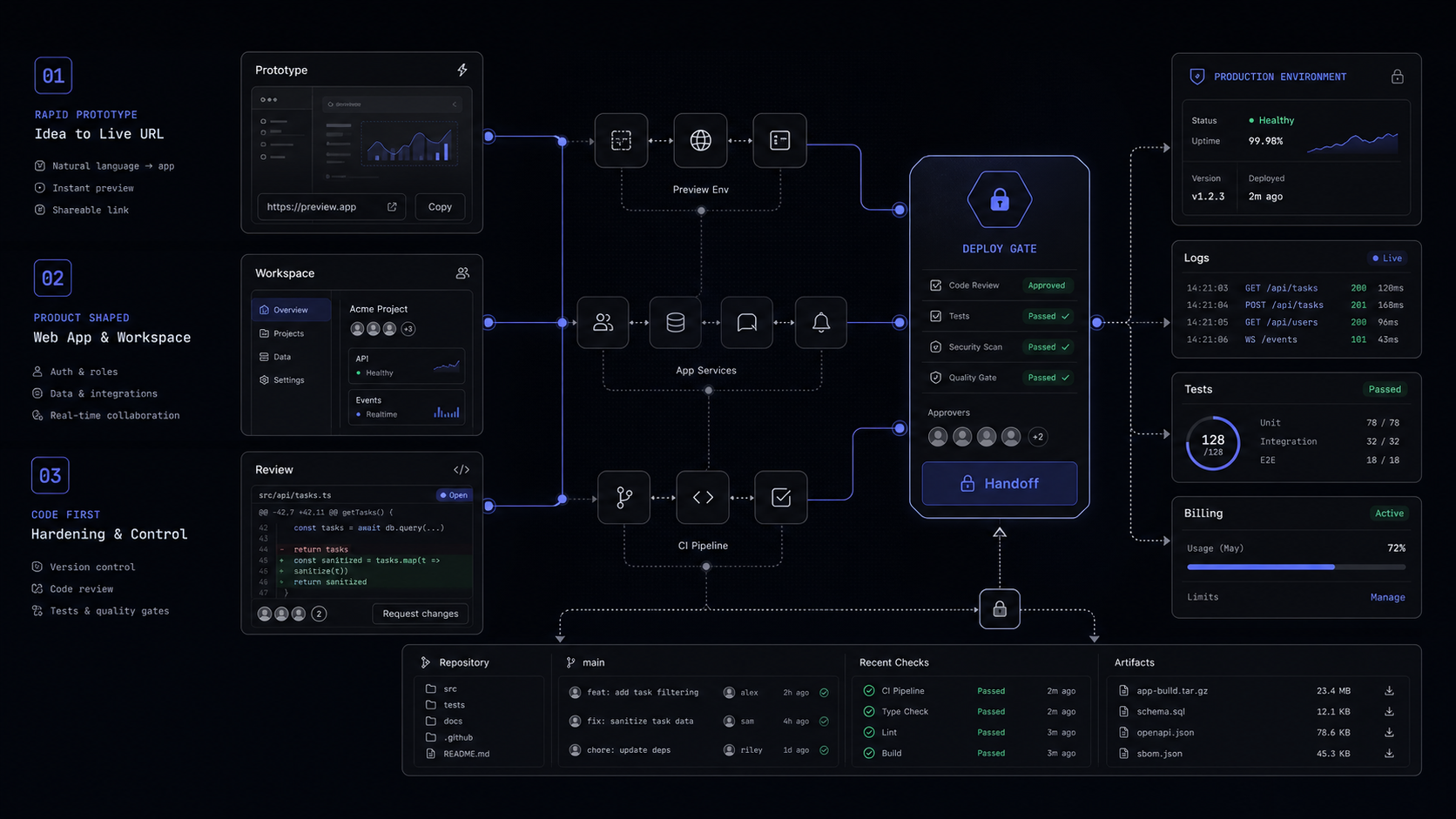
The version-one stack should use managed services where they remove operational drag. Managed does not mean careless. It means the team buys commodity infrastructure so the custom effort can go into the workflow, AI quality, and buyer-facing experience.
Here is a practical baseline for many AI SaaS MVPs:
This table is not a universal recommendation. It is a scoping baseline. A founder can change any vendor, but the replacement should answer the same questions: what is included, what scales with usage, what logs exist, what spend cap exists, and who owns production support.
The important cost lesson is that the fixed build price and the running product cost are separate. Vercel Pro plus Supabase Pro is a $45/month baseline before AI tokens, payment processing, auth add-ons, email, monitoring, and usage overages. That does not mean the product will cost $45/month to run. It means the first fixed-cost part of the managed stack is easy to see. The variable meters need their own controls.
For an AI SaaS MVP, model usage is the meter founders underestimate. OpenAI's pricing page shows why: a small-model workflow and a flagship-model workflow can have very different input and output costs. A sensible MVP routes routine extraction, classification, and formatting to the cheaper model that passes quality checks, then reserves expensive models for high-value cases. The product should save enough detail to answer, "Which user, workflow, prompt version, and model produced this bill?"
The same rule applies to payments and hosting. Stripe's percentage-plus-fixed card fee is expected. It should be included in the margin model. Vercel's pricing page says new teams have a default on-demand usage budget of $200 that can be customized, and projects can be configured to pause at 100% when a hard limit is set. Supabase Pro has a spend cap enabled by default. Those controls belong in the handoff notes, not only in the vendor dashboard.
For deeper AI pricing tradeoffs, use the meter breakdown in AI Agent Pricing: Seats vs Credits vs Resolutions before you add outcome-based billing or heavy agent workflows.
What To Exclude From Version One
Version one should exclude anything that does not help the first buyer complete the first workflow and prove willingness to pay.
Cut these unless there is a signed customer requirement:
- Native iOS and Android apps when a responsive web app can test demand.
- Multiple user personas with different dashboards.
- Enterprise SSO, SAML, and advanced roles before an enterprise buyer asks for them.
- Custom model training from scratch.
- Fine-tuning before prompt, retrieval, and workflow design have been tested.
- Multiple AI workflows with separate data models.
- A custom billing engine.
- A full analytics warehouse.
- Complex referral, affiliate, or partner systems.
- White-label theming.
- Public API access.
- Multi-language localization.
- Deep CRM, support, and marketing integrations.
Some of these features are valuable later. That is not the same as valuable now. Enterprise SSO is a good example. Clerk's current pricing page lists one enterprise connection per app on Pro and Business, with paid tiers for additional connections. If the first customer requires SSO to start a paid pilot, include it. If not, it belongs in the backlog because it changes auth testing, support, sales promises, and sometimes tenant design.
The same discipline applies to custom model work. A founder may believe the product needs a custom model because the category sounds specialized. In many first releases, the better path is a managed model, a narrow prompt or retrieval workflow, structured outputs, and rigorous human review. Custom training can come later, after the team has real examples, failure cases, and usage patterns.
The version-one backlog should not be vague. It should list the cut feature, why it was cut, and the signal that would bring it back. For example:
That backlog is a buying tool. It protects the fixed price, and it makes later roadmap conversations factual instead of emotional.
Fixed Price, Hourly Agency, Or Freelancers
Fixed-price MVP development is the right buying model when the workflow boundary is clear enough to write acceptance criteria. It is not the right model when the product is still a set of possibilities.
Use this decision rule:
Founders often compare these paths only on day-one cost. That is incomplete. The real comparison is decision load.
A fixed-price studio should reduce decision load by turning discovery into a bounded build: what ships, what does not, what is accepted, what is handed over, and what happens when a feature request appears mid-build. A freelancer-heavy approach can work when the founder already knows the architecture and can act as product manager. An hourly agency can be the right partner when the product is strategically important but still ambiguous.
For AI SaaS, the quality bar is higher than a normal CRUD MVP. CRUD means create, read, update, and delete, the standard data operations behind many web apps. AI adds prompts, model selection, output validation, cost logging, retries, rate limits, abuse prevention, and human review. A cheap build that skips those controls is not a cheaper version of the same product. It is a different product.
The fixed-price proposal should therefore include acceptance criteria such as:
- The core workflow works end to end for a test user.
- Payment or pilot access is gated correctly.
- The AI output is saved with prompt version, model, input, output, timestamp, and user decision.
- The admin can inspect usage and failures.
- The product has a documented fallback for model errors, timeouts, and unsafe outputs.
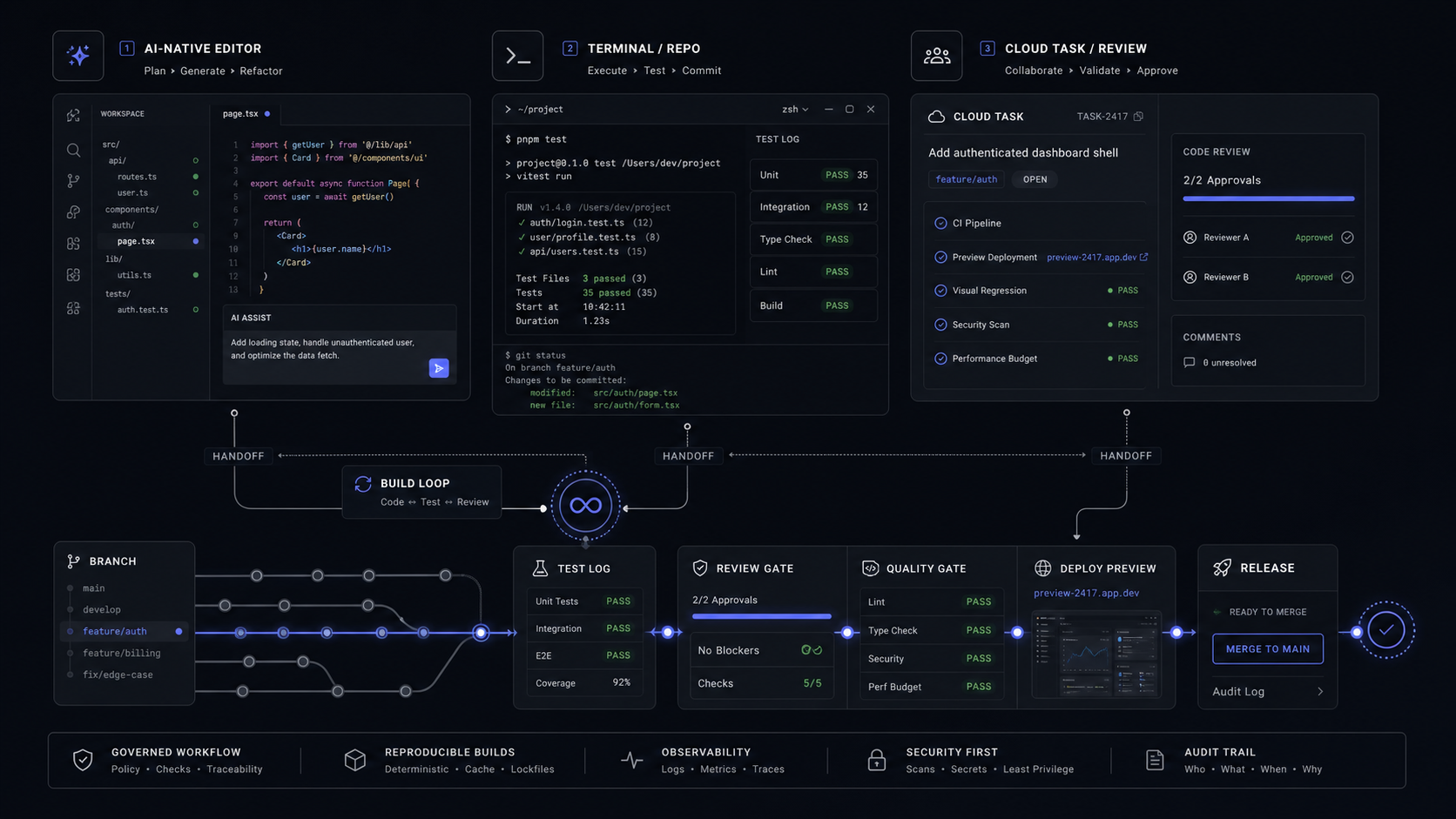
- Environment variables, vendor accounts, and deployment notes are handed over.
- Known limits and next-scope recommendations are documented.
If a proposal only lists screens, it is not a serious AI SaaS MVP proposal. It should list operating behavior.
The Handoff That Makes The MVP Ownable
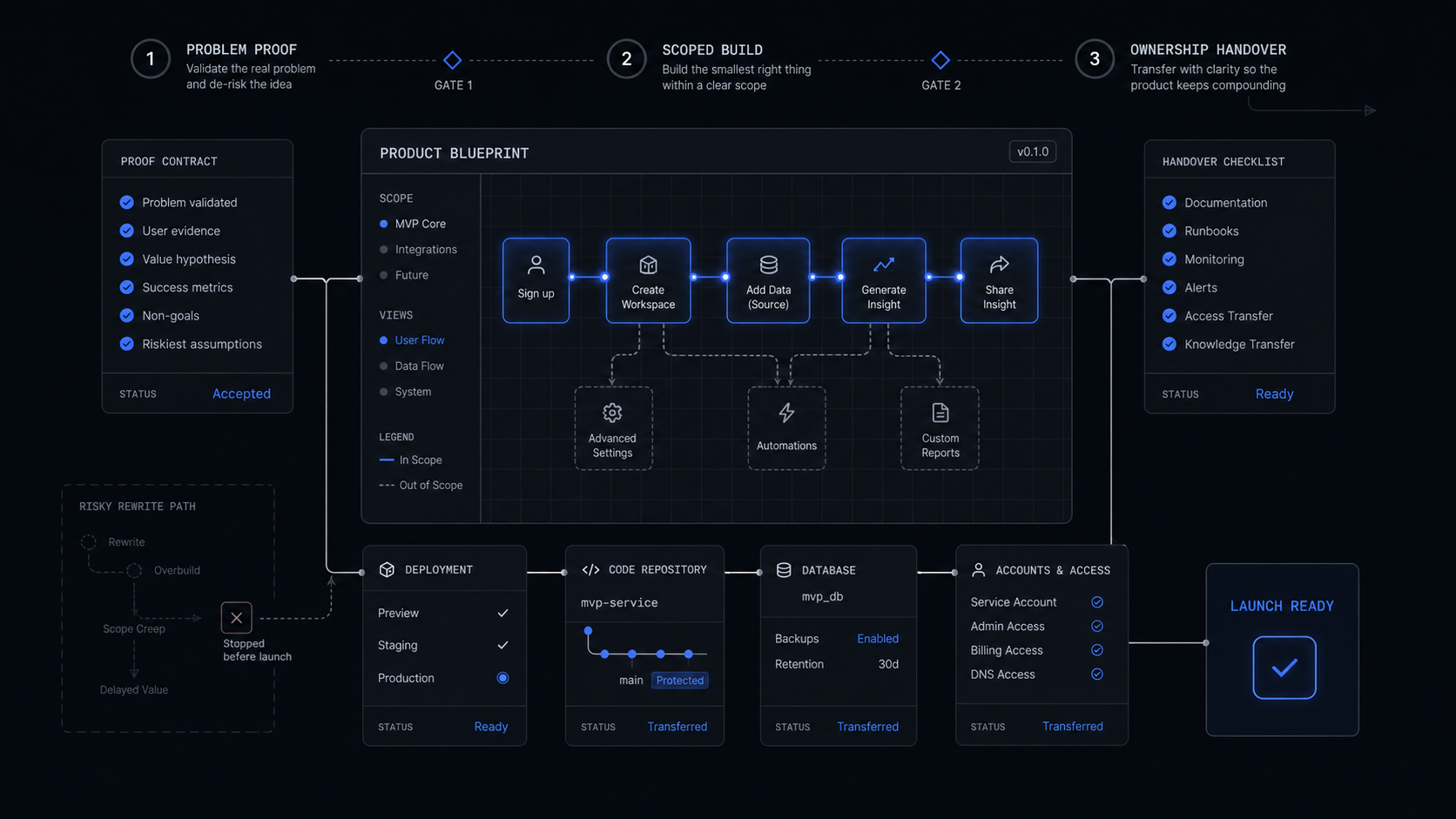
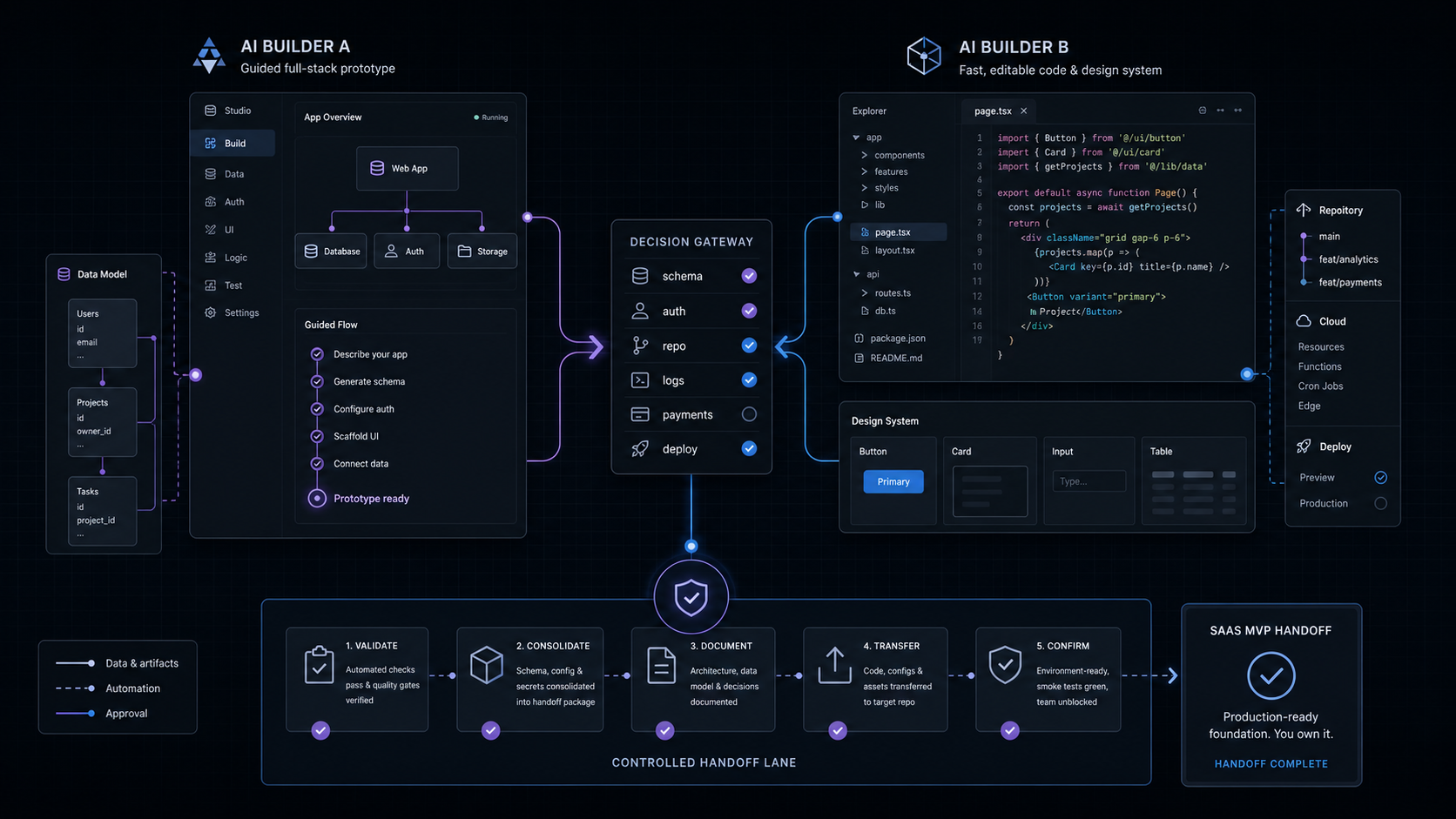
The handoff is where many MVP builds reveal whether they were built as a product or as a demo. A founder should receive enough context to run, review, and extend the system without depending on the original builder for every small decision.
The minimum handoff pack should include:
- Repo access with a clean README.
- Production and preview deployment notes.
- Environment variable list, with secrets stored in the right vendor dashboards.
- Vendor account ownership map.
- Database schema notes and migration instructions.
- AI prompt or workflow versions.
- Model selection rationale.
- Usage and cost logging explanation.
- Admin dashboard walkthrough.
- QA checklist and known failure cases.
- Backlog split into "next release," "later," and "do not build unless signal changes."
- A short architecture diagram.
The AI-specific part matters most. The founder should know which model is used for which task, why that model was chosen, how to change it, where the logs live, and what behavior should trigger manual review. OpenAI's pricing page points users to a usage tracking dashboard for current and past billing cycles. That dashboard is useful, but it is not a product-level audit trail. The MVP should keep its own workflow-level usage records so product decisions are not buried inside an infrastructure bill.
The cleanest handoff also includes "scope decisions." These are the decisions made during the build, not just the features shipped. For example: "We did not add SAML because no first buyer required it," or "We used GPT-5.4 mini for extraction because quality passed review at a lower per-token cost than GPT-5.5 for this task." Those notes help the next builder or internal hire understand the product logic without reopening every old argument.
A Practical Scope Template
Use this template before asking for a fixed-price quote:
Write the workflow
The user is:
<segment>. They currently do:<manual or tool-based process>. The MVP will help them:<one outcome>. They will pay because:<business reason>.Define the data
List every input needed for the first workflow: files, forms, connected accounts, URLs, CRM objects, support tickets, transcripts, or database records. If the data is messy, include cleanup in scope.
Choose the AI behavior
Pick one: retrieve, classify, draft, extract, summarize, route, recommend, or decide inside a bounded workflow. Avoid bundling five AI behaviors into the first release.
Set the review rule
Decide what ships automatically and what waits for human approval. For a new AI SaaS MVP, review states are often the difference between a usable product and a risky demo.
Name the paid gate
Choose how a user gets access: paid subscription, pilot code, manual invoice, invite-only account, or trial. If payment is included, keep the first pricing model simple.
List the hard exclusions
Write the "not now" list before build starts. A fixed-price scope needs exclusions as much as inclusions.
Here is the sentence a good scope should produce:
Version one lets a compliance consultant upload one vendor questionnaire, generate a cited risk-response draft, review each answer, export the final response, and track model usage by project.
That sentence is buildable. It tells the studio the user, input, AI behavior, review point, output, and logging need. It also makes the first release easier to price, test, and hand over.
What is SaaS MVP development?
SaaS MVP development is the build of the smallest subscription-ready software product that can test a real customer workflow. For an AI SaaS product, that includes the AI behavior, the surrounding app, and the logs needed to inspect cost and quality.
What is MVP development services?
MVP development services turn a product idea into a working first release. A serious AI SaaS MVP service should include product scoping, UX, app development, AI workflow design, payments or access control, QA, deployment, and handoff.
How much does a SaaS MVP cost?
The honest number depends on scope, but the cost is controlled by the first workflow boundary. The fastest way to make an MVP expensive is to add extra personas, custom model work, enterprise auth, mobile apps, and multiple dashboards before the first paid workflow is proven.
Is MVP agile or waterfall?
An MVP should be scope-controlled and delivered in reviewable increments. Fixed price sets the boundary, while short milestone reviews keep the work aligned with what the buyer needs to validate.
Scope Your AI SaaS MVP
Turn one paid workflow into a fixed-scope AI SaaS MVP with the product surface, AI controls, and handoff needed to launch cleanly.
Jun 5, 2026