Pitch Deck Design Agency vs AI Generator: What to Buy Before a Raise
Compare AI tools, freelancers, and pitch deck agencies by cost, narrative judgment, revision control, and handoff before your fundraise.

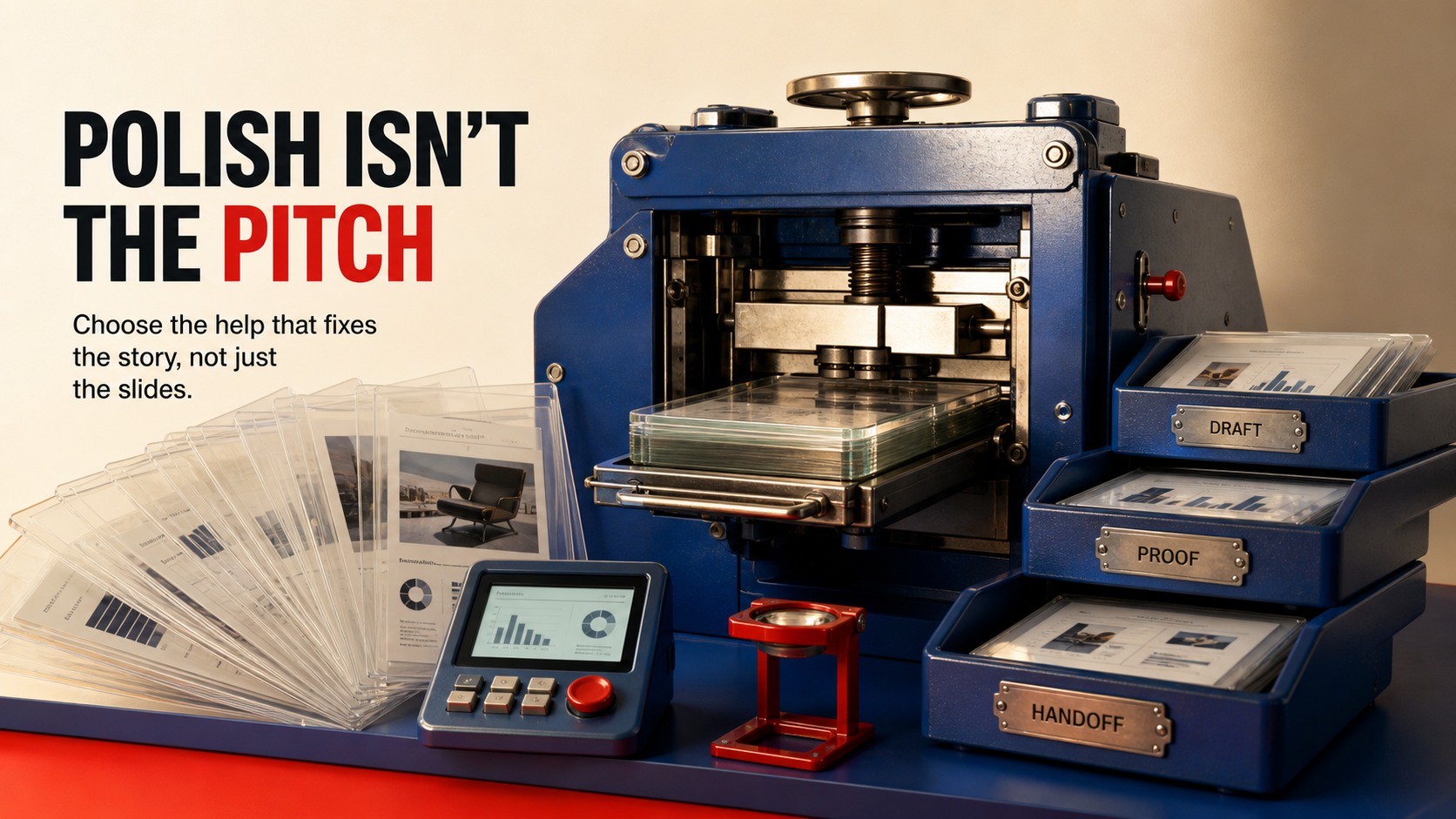
Use an AI pitch deck generator when your story is settled and you need a fast first draft. Hire a specialist when the expensive risk is the story itself: what to cut, which proof to lead with, and whether the deck can survive an investor forwarding it without you in the room.
The verdict: buy judgment only when the story is unsettled
The right buying path depends on whether you need slide production or narrative judgment. Narrative judgment is the ability to decide which argument the deck should make, which evidence earns belief, and which material should disappear. An AI presentation tool can accelerate production. A skilled freelancer can turn approved content into a coherent visual system. A specialist pitch deck agency should challenge the story before it decorates it.
That distinction matters because a fundraise deck has two jobs. It supports the founder in a live conversation, then becomes a leave-behind, a version that still works when an investor forwards it without the founder narrating. Y Combinator advises founders to make the deck a coherent leave-behind and notes that graphics, charts, and screenshots carry more weight than blocks of words.
Illustrative scenario: a pre-seed B2B founder already has a clear customer, a narrow problem, product screenshots, a defensible market entry, and approved traction data. That founder can use AI for the first layout and hire a freelancer for polish. If the same founder cannot decide whether the company is selling a workflow product, a data platform, or a cost-saving service, better typography will only make the confusion more expensive.
The separating axis is who owns the narrative
The strongest provider is the one that makes narrative ownership explicit. If nobody is responsible for deciding the claim, proof, sequence, and cut list, the founder remains the strategist while paying someone else to arrange the slides.
A good narrative process answers four practical questions:
- What should an investor remember after the deck is closed?
- Which customer evidence makes the problem credible?
- Which product proof makes the proposed wedge believable?
- What must be true for the round to create the next material milestone?
The visual system comes after those answers. It establishes hierarchy, makes comparisons readable, and keeps screenshots, charts, and claims consistent. It cannot decide which metric deserves the headline.
Illustrative decision walkthrough: imagine a vertical SaaS team with a traction slide that says adoption is growing. A production-only brief asks a designer to make the graph clearer. A narrative brief first asks whether the graph shows the behavior investors need to believe, whether the period is representative, and whether the headline states the implication. The design work is similar. The judgment being purchased is not.
This is also why a beautiful portfolio is insufficient evidence. Ask a prospective partner to diagnose one confusing slide before discussing visual direction. A useful diagnosis names the missing decision, not a preferred color or layout.
Compare AI, freelancer, and agency scope
The cheapest correct path can be dramatically less expensive than the wrong one. These are current published price signals from named providers and a marketplace, not claims about a universal market average.
Pitch's current pricing, Upwork's presentation designer rates, and Waveup's published pitch deck pricing make the scope difference visible. Tool access is inexpensive. Visual execution costs more. Narrative, stakeholder alignment, and revision control are what move a specialist engagement into a different buying category.

Do not compare a tool subscription with a full-service engagement as if both sell the same output. Compare what remains unresolved after each purchase. If the tool leaves the founder with an untested story, its low price did not remove the main risk. If an agency adds workshops and animation to approved copy that only needs a clean system, the extra scope is waste.
Use AI for structured production, not unowned judgment
AI is the right starting point when the founder can supply clean evidence, a stable story, and a usable brand template. The tool should turn known inputs into editable options, not invent the investment case.

Pitch is a useful current example. Pitch Agent can take a prompt, a selected template, and attached files, including a brief, call notes, or CSV data, then generate a deck with copy, varied layouts, and images. It can also refine the draft through chat by rewriting copy, splitting or merging slides, and replacing images. Pitch says the Agent can flag an unanswered objection and assess which slides are carrying the argument.
Those capabilities make it a strong production partner. They do not transfer accountability for factual accuracy, market logic, or the choice of evidence. Treat every generated claim as a draft that needs an owner.
Freeze the evidence
Collect approved product screenshots, customer language, traction definitions, market sources, and the use-of-funds logic. Remove speculative numbers and duplicate claims before generation.
Write the argument
Give the tool a plain-language statement of the customer, problem, wedge, proof, and fundraise milestone. If the team cannot agree on that statement, pause the tool and resolve the strategy.
Generate from real context
Attach the clean brief, approved notes, and source data. Use the actual brand template when one exists so the draft inherits a system rather than superficial colors.
Challenge every slide
Ask what decision the slide supports, whether the headline states an implication, and whether the visual proves the claim. Delete anything that only repeats the spoken pitch.

Pitch Free is $0 with 100 AI credits that do not renew once used, and its PDF export is branded. Pitch Plus is $15 per month or $13 per month with yearly billing, includes 6,000 AI credits per year, and lists extra credits at $0.004 each. Those limits are operating details, not a proxy for deck quality. The useful metric is how much founder review the generated draft still needs.
Hire a freelancer when the copy is settled
A freelancer is the efficient choice when the story, data, and approval chain are already stable but the deck lacks visual hierarchy. The brief should say whether the work is slide design, information design, copy editing, or narrative development. Those are different disciplines even when one person can perform several of them.
Upwork reports $35-$60 per hour as a typical presentation designer range. Its current guidance also shows $175-$360 for a small fixed-price project covering a 5-6 slide deck or template, and $1,050-$1,800 for a large fixed-price project covering a 30-40 slide pitch or brand deck. Use those as marketplace signals, then evaluate the actual portfolio, process, and contract.
Illustrative scenario: a product lead has approved messaging, a clean data pack, and an established brand system, but the current deck was assembled by several operators and no longer feels consistent. A presentation designer can consolidate layouts, rebuild charts, and create reusable slide patterns without reopening the investment thesis. Paying for a full strategy process would add ceremony to a solved problem.
The failure mode is silent scope expansion. A founder asks for design, then expects the freelancer to repair the market argument during revisions. Prevent that by separating content approval from visual approval and naming the person who owns each.
Hire a specialist agency when the story must survive scrutiny
A specialist agency earns its fee when the deck requires challenge across narrative, evidence, visual hierarchy, and stakeholder alignment. The deliverable is not a prettier file. It is a defensible argument expressed in an editable system.
Published agency packages show what changes as scope deepens. Hype lists a Refresh package at $2,500 for up to 10 slides, a Premium package at $4,450 for up to 10 slides, and an Ultimate package at $11,400 for up to 10 slides. The first refreshes existing collateral. The middle adds bespoke design, animation, project management, and one revision round per discipline. The largest adds discovery, storytelling and content development, template development, training, and additional revision rounds.

Waveup offers another transparent signal: $100 per slide when the client supplies content, or $5,000+ for strategy, narrative development, design, and revisions. It publishes a turnaround range from 2 business days for urgent delivery to a typical 2 weeks. These figures describe those providers, not every agency. They show why a quote is meaningless until the narrative and revision scope are visible.
Illustrative scenario: a technical founder has a working product and credible customer evidence, but the deck opens with architecture, buries the market wedge, and uses several definitions for the same buyer. A specialist should first resolve the audience, claim, and evidence sequence. Only then should it set typography or motion. If the deck is also exposing a missing company identity, use the startup branding budget by buying path to separate brand work from deck work before signing one blended quote.
Ask who leads discovery, who can rewrite the narrative, who approves data changes, and who remains accountable at final handoff. If the senior strategist disappears after the sales call, you are buying a production queue with agency pricing.
Scope the engagement around a usable handoff
The engagement is complete only when the company can revise, present, and repurpose the deck without returning to the provider for routine changes. That requires more than a final PDF.
Require these outputs in the scope:
- Editable source deck: the working file in the presentation platform your team will actually use.
- Live-pitch version: paced for a founder who is speaking and able to reveal detail through the conversation.
- Leave-behind version: coherent without narration, with sources and enough context to survive forwarding.
- Evidence pack: approved chart data, source links, screenshot provenance, and definitions for every key metric.
- Reusable slide system: layouts for common claims, charts, product proof, team updates, and the fundraise ask.
- Revision protocol: named approvers, feedback format, included rounds, exclusions, and the rule for late evidence changes.
The same discipline used when scoping a SaaS website agency engagement applies here: define the decision, the content owner, the production boundary, and the owned handoff before comparing quotes.
Illustrative handoff test: remove the presenter, send the leave-behind to a trusted operator who was not in the project, and ask them to retell the problem, wedge, proof, and use of funds. If the retelling changes the company, the deck is not ready. If the operator cannot edit a chart or replace a product screenshot without breaking the system, the handoff is not complete.
Use this decision rule before you buy
Choose AI when the argument is stable, the evidence is approved, and the founder has time to review every output. Choose a freelancer when the content is stable but the visual execution is not. Choose a specialist agency when the argument itself must be challenged, aligned across stakeholders, and made durable for a high-stakes raise.
Before approving a quote, ask:
- What specific uncertainty will this provider remove?
- Who owns the narrative and can change it?
- What proof must be supplied by the company?
- What editable files and reusable systems will the company own?
- What happens when new evidence arrives during revision?
If the provider cannot answer those questions in the scope, the engagement is not fixed enough to compare. A low quote can hide unowned strategy. A high quote can hide unnecessary production. The right scope makes both visible.
How much does a pitch deck design agency charge?
Published prices depend on what the agency owns. Waveup lists $100 per slide for design only and $5,000+ for strategy, narrative, design, and revisions. Hype lists up to 10-slide packages at $2,500, $4,450, and $11,400 as the scope grows from refresh to end-to-end support. Treat these as current provider examples, then compare your own quote line by line.
How do I choose the right pitch deck design agency?
Give each candidate a confusing slide and ask for a diagnosis. The right partner should identify the decision, missing evidence, narrative problem, and handoff risk before proposing a visual direction. Also verify who leads the work, what revisions include, and which editable source files you will own.
When should I hire a pitch deck design agency instead of doing it myself?
Hire a specialist when the story is still contested, the evidence is complex, several stakeholders must approve the argument, or the deck must work as a forwarded leave-behind during an active raise. Use a tool or freelancer when those problems are already solved and the remaining work is production.
Scope Your Deck
Bring the story, evidence, and deadline. We will scope the narrative, design system, revision path, and editable handoff.
Jul 14, 2026