Generative Engine Optimization Services: What Your Product Site Actually Needs
What to buy from GEO services, what to build into your product site, and how to make AI-search visibility crawlable, citable, and measurable.

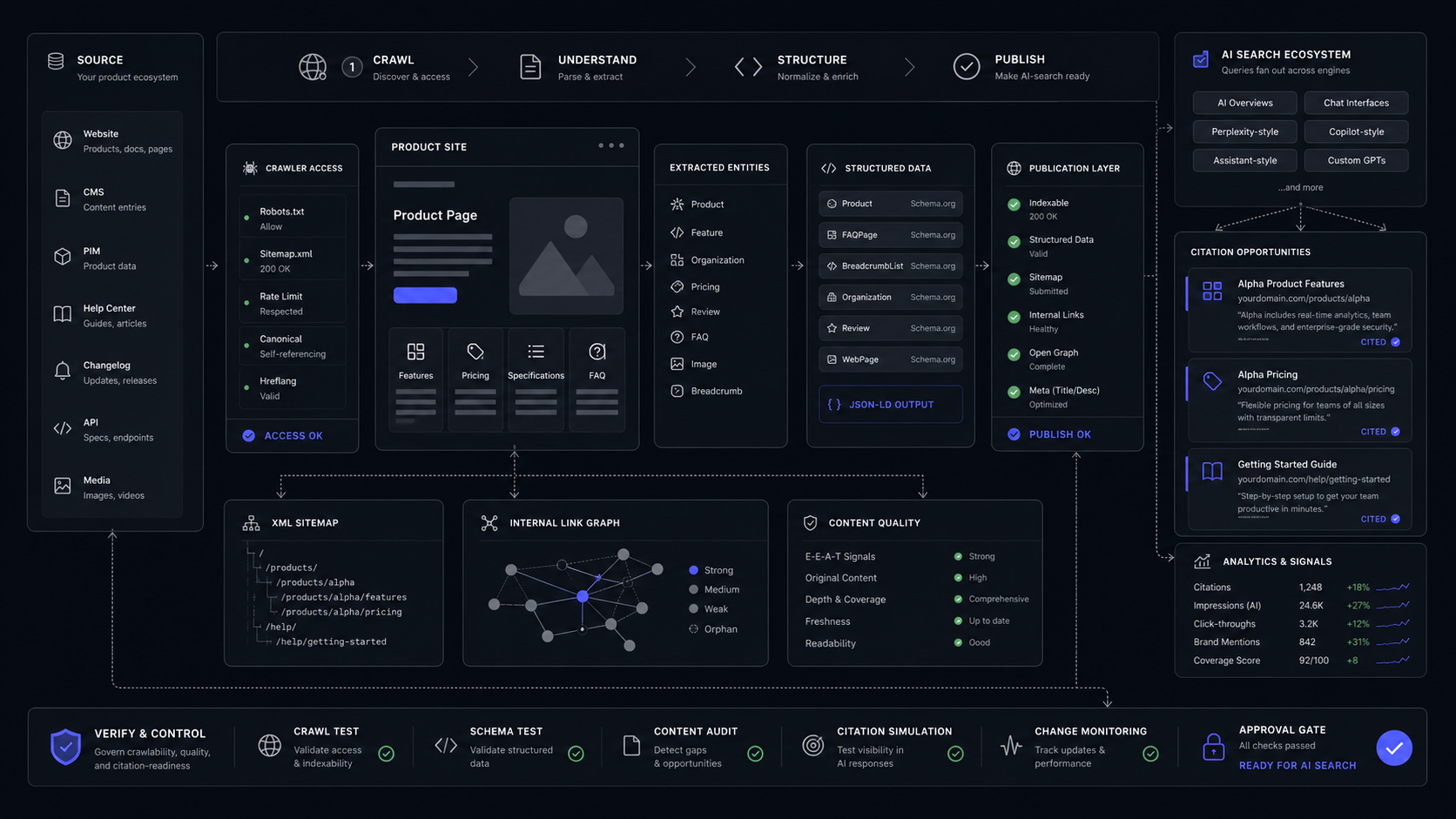
Generative engine optimization services are worth buying for the audit, monitoring, and query strategy. The durable work belongs in the product site: crawlable pages, specific claims, clean internal links, structured data that matches visible content, and proof an AI answer can cite without guessing.
The Short Verdict
Buy GEO services for the map, not the foundation. Generative engine optimization, often shortened to GEO, is useful when it tells a SaaS or AI product team which buyer questions, comparison gaps, and citation weaknesses need to be fixed. It becomes waste when it turns into a monthly package of vague prompts, hidden markup, and promises that no vendor can control.
The site itself has to carry the work. Google's AI features and your website guidance says the same foundational SEO best practices apply to AI features as to Google Search overall, and that a page must be indexed and eligible to appear in Search with a snippet before it can be eligible as a supporting link in AI Overviews or AI Mode. Google also says there are no additional technical requirements for those AI features. That should reset the buying decision: the first build is still crawlability, page quality, internal links, visible evidence, and useful structure.
ChatGPT Search has its own practical control point. OpenAI's ChatGPT Search guidance says there is no way to guarantee top placement, but site owners should allow OAI-SearchBot and make sure their host or CDN allows OpenAI crawler traffic. That is not a content trick. It is product-site infrastructure: robots rules, edge/firewall rules, renderable content, analytics, and source pages that answer the exact questions a buyer asks.
For a funded founder or product lead, the right question is not "Do we need GEO?" The sharper question is: "What would an AI answer cite from our site tomorrow, and would that page help a real buyer decide?" If the answer is unclear, the product site is the constraint.
What A GEO Service Should Actually Deliver
A useful GEO service should leave you with decisions, not jargon. The minimum useful package is an answer map, a citation map, a page scope, and a measurement plan.
The answer map lists the real questions a buyer asks before contacting you: "best customer support AI for B2B SaaS," "AI onboarding assistant vs chatbot," "SOC 2 workflow automation with human approval," or "Framer vs Webflow for SaaS product sites." The service should group those questions by buying stage, show which existing pages can answer them, and mark which pages do not exist yet.
The citation map is more direct. It shows which sources AI answers and search features already rely on for your category: review sites, docs, comparison pages, pricing pages, analyst pages, GitHub repos, app marketplaces, or vendor help centers. This matters because AI answers need sources they can trust enough to quote or link. If your only page is a polished homepage with a slogan, there is nothing specific to cite.
The page scope turns that research into buildable work. A good brief says, for example:
Define the decision page
Create
/compare/intercom-fin-alternativefor buyers comparing resolution pricing, custom handoff rules, and support-ticket ownership. The page must state who the product is for, who it is not for, pricing assumptions, setup requirements, and the handoff model.Define the source sections
Add a visible pricing model section, a control checklist, a security and data-use section, and an FAQ. Do not place claims only in metadata or schema. Google says structured data should describe visible page content, not invisible claims.
Define measurement
Track organic search, AI-search referral traffic, form submissions, and page-level assisted conversions. OpenAI says ChatGPT includes
utm_source=chatgpt.comin referral URLs for publishers who allowOAI-SearchBot, so that traffic should be visible in analytics when it arrives.
The measurement plan should be honest about attribution. Google says AI feature appearances are included in Search Console Performance reporting under the Web search type. That means you can measure search impact, but you should not expect a neat "AI Overview impressions" report for every page. The better operating view is page-level: which pages were shipped, which queries moved, which citations or source panels started appearing, which demo requests or qualified leads touched those pages.
Skip a GEO vendor if the deliverable is "we will make you appear in ChatGPT." OpenAI says ranking in ChatGPT Search depends on factors designed to help users find reliable, relevant information and there is no guaranteed top placement. A vendor can improve the surface area, not control the answer.
What Belongs In The Product Site
The product site should make the answer easy to extract and hard to misunderstand. That means each important buyer question gets a page or section with visible claims, plain structure, current details, and enough proof to support the claim.
Start with the core product pages:
For an AI product or SaaS company, these pages need more than marketing language. A product overview should name the workflow, the system of record, the user role, and the control point. A comparison page should say when not to buy. A pricing page should define scope, usage assumptions, and handoff. An integration page should state whether data is read-only, synced both ways, or written back after approval.
Structured data helps only when it reflects that visible substance. Google's structured data introduction says structured data gives explicit clues about the meaning of a page and classifies page content. It also says the structured data on a page should describe the content of that page, should not sit on blank or empty pages, and should not describe information that users cannot see. Treat schema as a clean label on a strong shelf, not a hidden second website.
For a product-site build, the practical schema set is usually:
Organizationfor the company entity, official site, same-as links, contact details, and logo.ProductorServicefor the actual offer, with visible name, description, category, brand, and offer details where appropriate.FAQPagefor pages that truly present questions and answers. Schema.org defines FAQPage as a webpage presenting one or more frequently asked questions.BreadcrumbList, article, and webpage metadata for crawlable hierarchy and page identity.
Google says JSON-LD is recommended in most cases because it is easiest to implement and maintain, while valid JSON-LD, Microdata, and RDFa are supported unless a specific feature says otherwise. In a production site, JSON-LD is usually the easiest to test, version, and generate from CMS fields.
Internal links matter because answer systems and crawlers need context. Link a GEO page to the product-site platform decision if the buyer is still choosing a stack, for example Framer vs Webflow for SaaS product sites. Link prototype guidance to production-readiness content, for example Lovable AI Website Builder Review, when the buyer needs to understand why a quick prototype is not the final website.
The Crawl And Control Layer
The crawl layer decides whether the right systems can reach the right pages. It is not glamorous, but it is where many GEO projects fail.
For Google, the control model is familiar. Google says Googlebot robots.txt directives are the control for managing Search crawling for AI features in Search. It also lists nosnippet, data-nosnippet, max-snippet, and noindex as controls for limiting information shown from your pages. That means your product-site build needs a deliberate crawl policy:
- Public product, pricing, comparison, use-case, integration, and docs pages should be crawlable unless there is a legal or security reason to block them.
- Private app routes, account pages, staging paths, and internal dashboards should be blocked or protected at the application and infrastructure level.
- Pages that should not appear in search should use
noindex, not just a robots block. - Snippet restrictions should be used carefully, because snippet eligibility affects the page's ability to support AI features in Google Search.
For ChatGPT Search, OpenAI gives two separate crawler decisions that buyers often confuse. In its Publishers and Developers FAQ, OAI-SearchBot is the crawler OpenAI names for ChatGPT Search inclusion, summaries, snippets, citations, and links. GPTBot is the crawler OpenAI says publishers should disallow from sites and pages they wish to exclude from potential training. Those are not the same business decision.
There is also a firewall and CDN layer. OpenAI says site owners should make sure the host or CDN allows traffic from OpenAI published IP addresses. A robots.txt file can say "allow," while a bot rule, WAF, or edge firewall still blocks the request. The production check should test both: crawler permission and actual fetchability.
Freshness is its own control. IndexNow says it lets site owners inform search engines when a URL and its content has been added, updated, or deleted. It also says that without IndexNow, it can take days to weeks for search engines to discover changed content because they do not crawl every URL often. A product site with pricing, comparison, and launch pages should have a sitemap and a freshness path: update the page, update lastmod, ping where appropriate, and log the change.
A Fixed Product-Site Sprint For GEO Readiness
The first GEO-ready product-site sprint should ship pages and instrumentation, not a strategy deck. A tight scope is usually enough to prove whether the site can become a credible source.
Here is a practical sprint for a SaaS or AI product company:
Build the claim register
Create a source-of-truth table with the claims the company is allowed to make: product category, core use cases, integrations, security posture, pricing or scope boundaries, implementation timeline, and proof points. Each claim needs an owner and a source. If a claim is not approved, it does not go on the site.
Ship the six-page surface
Build or rebuild the homepage, product page, one use-case page, one comparison page, one pricing or scope page, and one integration or docs page. Each page gets a specific buyer question as its first job. The homepage should route. The deeper pages should answer.
Add structured data from real fields
Generate JSON-LD from CMS or code fields that are also visible on the page. Use Organization, Product or Service, FAQPage where appropriate, breadcrumbs, and article or webpage metadata. Validate with Google's Rich Results Test before launch.
Set crawler policy
Review robots.txt, meta robots, canonical tags, sitemap, CDN bot rules, and private route protection. Allow the pages meant to be discovered. Keep private and staging content out of the index.
Instrument AI-search referrals
Track page views, qualified conversions, source/medium, assisted conversions, and query movement. OpenAI says ChatGPT uses
utm_source=chatgpt.comin referral URLs for publishers who allowOAI-SearchBot, so add it to reporting rather than grouping it under generic referral traffic.Run a monthly source review
Review which pages are being cited, which questions still produce competitor answers, which claims are stale, and which comparison pages need updating. AI-search visibility changes only matter if the underlying page remains accurate.
For a concrete example, imagine a B2B SaaS company selling an AI support-resolution system. A weak site says: "Automate customer support with AI." A GEO-ready product page says: "Resolve repetitive billing, setup, and account-status tickets inside Zendesk or Intercom, route refunds and angry customers to humans, and log every AI answer with source links and confidence." The second version gives a buyer and an answer engine something to work with.
The same rule applies to pricing. "Contact us" is sometimes necessary, but it should not be the only pricing information. A scoped product-site page can say: "Discovery starts at a fixed price, the sprint includes one support queue, two systems of record, human approval, escalation rules, analytics, and handoff documentation. Out of scope: voice support, multilingual QA, and write-back automation without approval." That level of specificity helps the buyer and creates a citable source.
Buy, Build, Or Skip
Buy the parts that require external visibility and repeated monitoring. A GEO service can be useful for query research, answer tracking, competitor citation analysis, digital PR direction, and page briefs. It can also train the internal team on how answer engines phrase questions and which sources are being cited in the category.
Build the parts that define the company. Your product pages, comparison pages, scope pages, docs, pricing boundaries, integration explanations, and proof library should live in your product site and CMS. Outsourcing the whole surface to a GEO vendor creates a fragile dependency: the vendor can produce copy, but your team still owns truth, approvals, engineering constraints, and commercial positioning.
Skip guaranteed-placement packages, hidden text, fake review pages, generic "best tools" posts, and schema that says more than the page itself. These tactics create maintenance risk and do not solve the real problem: the company has not made a clear, crawlable, verifiable case for why it should be cited.
The controlled system wins because it compounds. Once the site has clear pages, schema, crawl access, internal links, analytics, and a claim register, every future launch gets easier. New product feature? Add it to the source-of-truth claims, ship the page, update structured data, refresh the sitemap, and monitor the queries. That is better than buying another acronym every quarter.
Are generative engine optimization services worth it?
They are worth it when they produce a practical query map, citation audit, and page plan your team can ship. They are not worth it when the offer is a guaranteed AI-answer placement without fixing crawlable product-site content.
Is GEO different from SEO?
GEO is best treated as a layer on top of SEO. Google says the same foundational SEO best practices apply to AI features as to Search overall, so crawlability, useful content, snippets, internal links, and page quality still matter.
How do I get my site into ChatGPT Search?
OpenAI says any public website can appear, but there is no guaranteed top placement. To be included in summaries and snippets, publishers should make sure they are not blocking OAI-SearchBot and that their host or CDN allows OpenAI crawler traffic.
Does structured data guarantee AI citations?
No. Structured data helps systems understand page content, but Google says it should describe visible page content and should be validated. Use schema to clarify strong pages, not to make unsupported claims.
What should a SaaS company build first for AI-search visibility?
Build the core decision pages first: product, use case, comparison, pricing or scope, integration, and FAQ. Then add JSON-LD, crawler controls, sitemap freshness, analytics, and a monthly review of citations and stale claims.
Scope Your Product Site
Build a product site that explains the offer clearly, supports AI-search discovery, and gives buyers the proof they need to act.
Jun 8, 2026