Base44 vs Lovable vs Bolt vs Replit: Which AI App Builder Should You Trust?
Compare Base44, Lovable, Bolt, and Replit by price, code control, deployment, and when an MVP needs scoped production work.

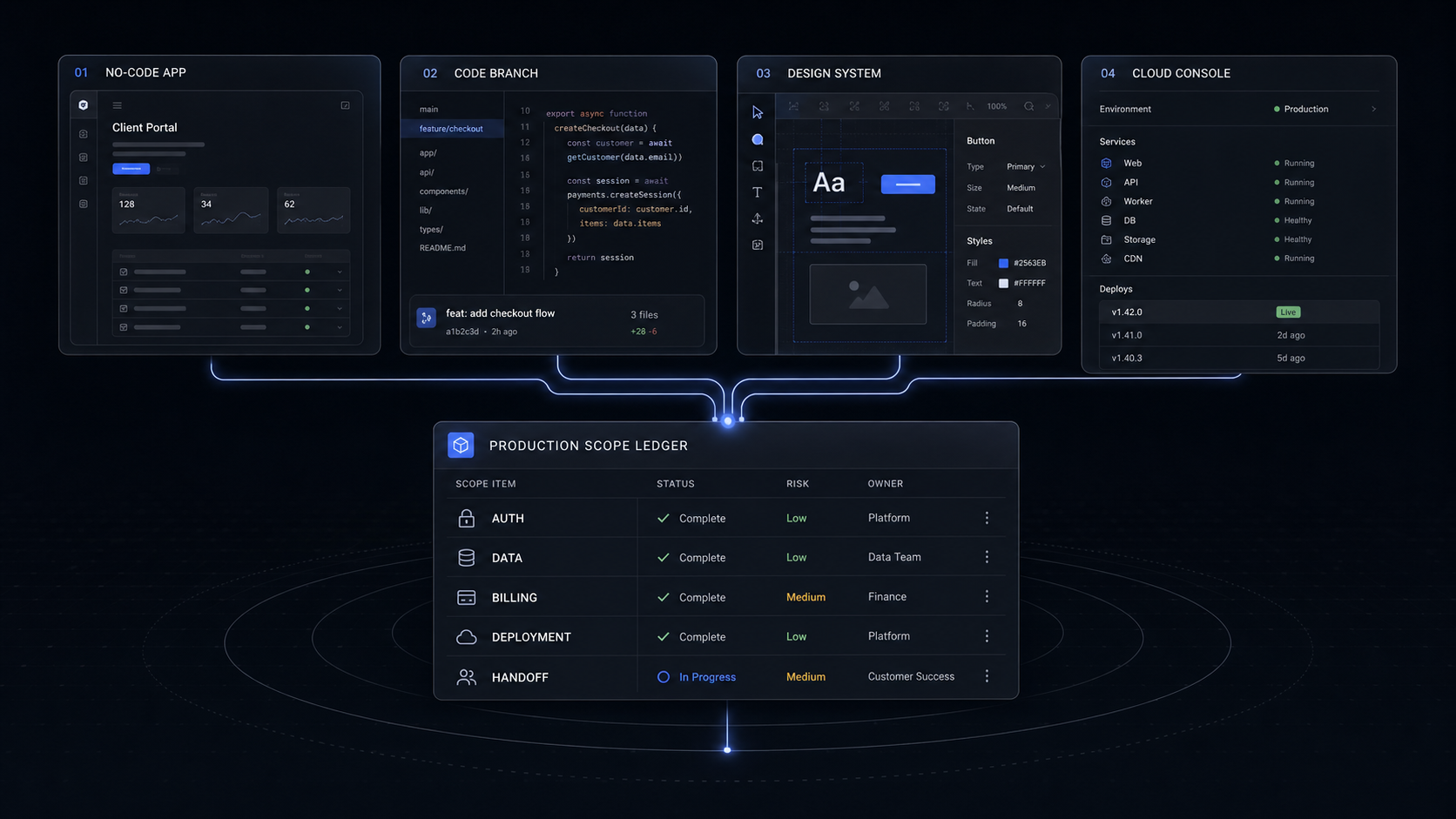
Use Base44, Lovable, Bolt, or Replit to validate the workflow, not to outsource the product decision. Base44 is the fastest no-code path, Lovable is the cleanest founder-friendly code ownership path, Bolt is strongest for design-led web prototypes, and Replit gives technical founders the deepest control.
The Short Verdict
The right AI app builder is the one that proves your riskiest assumption without trapping the real product in the wrong operating model. Base44 is the fastest path when a non-technical founder needs a hosted proof of workflow. Lovable is the best default when you want natural-language speed and a codebase that can be synced to GitHub. Bolt is strongest when the first proof is a polished web product with hosting, databases, design-system work, SEO, and custom domains in the same flow. Replit is the best fit when a technical founder wants the AI agent inside a real cloud IDE with deployment choices.
The blunt rule: build the first proof in the fastest tool that matches the buyer risk, then scope the owned production version before launch traffic, paid users, or investor diligence turns the prototype into a liability.
The Axis That Matters: Demo Speed vs Production Control
The real comparison is demo speed against production control. A founder does not need the most impressive first generation. A founder needs to know whether the next version can handle auth, data, permissions, payments, logs, usage limits, deployment, and handoff without a rebuild.
Base44 sits closest to the no-code end of the spectrum. Base44 says it builds fully-functional apps in minutes with just your words and no coding necessary. It also says it automatically sets up logic and infrastructure, including user logins, authentication, data storage, and role-based permissions. That is useful when the job is, "Can this workflow make sense to a customer?" It is weaker when the job is, "Can this become the core system our team owns?"

Lovable is the middle path with the clearest handoff language. Lovable docs say Lovable generates a working application that includes frontend, backend, database, authentication, and integrations, all backed by editable code. Lovable docs also say each project produces a codebase that can be synced to GitHub and integrated into existing engineering workflows. That makes Lovable stronger than a pure hosted mockup when a founder needs to learn quickly but still preserve the option to hand work to engineers.

Bolt is strongest when the first proof is visual, frontend-heavy, and tied to an actual site workflow. Bolt homepage says users can build or import from Figma and GitHub. Bolt homepage also says Bolt Cloud includes hosting, databases, integrations, user management and authentication, SEO optimization, analytics, and custom domains. That makes Bolt useful for launch-site-like products, internal demos, and product screens where design-system alignment matters from day one.

Replit is the technical founder's choice when the app is not just a page generator. Replit deployment types include Autoscale Deployments, Reserved VM Deployments, Scheduled Deployments, and Static Deployments. Replit is more demanding than the prompt-first tools, but that is the point: if your prototype needs background jobs, APIs, scheduled work, deployment cost visibility, and collaborators in a real workspace, Replit exposes more of the machinery.

Price And Meter Comparison
The visible subscription price is not the cost model. Each platform has a different meter, and the meter tells you what kind of product it wants you to build.
Base44 is priced like a rapid app-builder with two explicit meters. Base44 Starter is $16/mo billed annually with 100 message credits/mo and 2,000 integration credits/mo. Base44 Builder is $40/mo billed annually with 250 message credits/mo and 10,000 integration credits/mo. Base44 Pro is $80/mo billed annually with 500 message credits/mo and 20,000 integration credits/mo. Base44 Elite is $160/mo billed annually with 1,200 message credits/mo and 50,000 integration credits/mo.
The important Base44 upgrade is not only credit volume. Base44 Free includes core Base44 features, authentication, database functionality, and analytics. Base44 paid plan highlights include unlimited apps, in-app code edits, backend functions, AI model select, domain connection, and GitHub integration on Builder and above. For a founder, that means Free can validate whether the workflow exists, but Builder is the more realistic starting point if the app needs custom domain, backend functions, and a handoff path.
Lovable is priced like a collaborative builder with a credit account. Lovable Pro is $25 per month on annual billing and is shared across unlimited users. Lovable Business is $50 per month on annual billing and is shared across unlimited users. Lovable Pro credits are 100 credits / month and Lovable Business credits are 100 credits / month. Lovable paid subscriptions include daily grants of 5 build credits and a monthly grant of 20 Cloud credits.
The credit detail matters because every prompt is not equal. Lovable Plan Mode costs 1 credit per message. Lovable example prompts cost 0.50 credits to make a button gray, 0.90 credits to remove a footer, 1.20 credits to add authentication with sign up and login, and 1.70 credits to build a landing page with 3 generated images, theme, and 5 sections. A founder should budget credits around build steps, not around calendar time.
Bolt is priced around tokens, and tokens become a scope-control problem. Bolt says most token usage is related to syncing the project file system to the AI and that larger projects use more tokens per message. Bolt Pro is $25 per month billed monthly with no daily token limit, starting at 10M tokens per month, up to 1M web requests, custom domain support, SEO boosting, unlimited databases, expanded database capacity, choice of database provider, and image editing with AI. Bolt Teams is $30 per month and member billed monthly, adding centralized billing, team-level access management, admin controls, user provisioning, organization sharing, private NPM registries, and design system knowledge with per-package prompts.
That makes Bolt cheap for a narrow prototype and expensive in attention if the file tree grows without architecture. If your prototype starts as a marketing-led app, keep it to one workflow, one database shape, one primary conversion path, and one admin surface. The moment every new prompt edits ten unrelated files, the token meter is telling you the scope is drifting.
Replit is priced around seats, credits, agent parallelism, and published app usage. Replit Core is $20 per month, or $18 per month billed annually, with $20 of monthly credits, up to 5 collaborators, up to 2 agents in parallel, unlimited workspaces, and Replit AI integrations. Replit Pro is $100 per month, or $90 per month billed annually, with $100 monthly credits, up to 15 collaborators, up to 50 viewers, up to 10 agents in parallel, access to the most powerful models, database rollbacks for up to 28 days, and premium support.
Replit's publishing math is unusually transparent for prototype hosting. Replit Autoscale Deployments have a $1 base fee per month, $3.20 per million compute units, and $1.20 per million requests. Replit docs give an API service example at 300,000 requests/month with total cost about $14.27. That is not a complete SaaS bill, but it is enough to model early API traffic before you pick a production host.
Which Tool Fits Which MVP Scenario
Base44 is the right first tool when a non-technical founder needs a simple app live quickly and the first risk is workflow clarity. A good Base44 test is an onboarding portal, a lightweight dashboard, a request intake flow, or a small internal tool where the question is, "Will users understand and complete the job?" Base44 says its platform includes built-in hosting, analytics, and custom domains, so you can validate the surface without assembling a separate stack.
Do not ask Base44 to settle production architecture. Use it to learn the workflow, copy that learning into a proper scope, then decide what needs to be rebuilt, exported, or replaced. If the MVP depends on complex tenant permissions, payments, audit logs, custom data retention, or multiple external systems, the product risk has already moved beyond first-build speed.
Lovable is the best default when a founder wants fast iteration and wants to preserve code ownership. Lovable says users own the projects and code, including apps, websites, projects built with Lovable, customer data stored in Lovable, and AI output generated in Lovable, subject to third-party model rights. Lovable docs list SOC 2 Type II, ISO 27001:2022, and GDPR compliance, which matters when a team wants the tool to fit into a more serious operating model.
The strong Lovable use case is a SaaS MVP with one core workflow: sign up, connect data, produce a useful result, let the user act, and record the outcome. It is not a substitute for product judgment. You still need to define the data model, the permission model, the billing boundary, and the launch site around it. If your internal team is also choosing coding assistants for the next build stage, compare the tool budget separately in AI coding assistant pricing, because builder credits and engineering assistant seats solve different problems.
Bolt is the right choice when the first version is productized enough that design and web delivery matter. Bolt Free is $0 with public and private projects, a 300K tokens daily limit, 1M tokens per month, website hosting, up to 333k web requests, and unlimited databases. That is generous for a focused proof. The danger is interpreting generous limits as permission to keep expanding the product.
The best Bolt project is a tight web app with a clear UI spine: a logged-in dashboard, a small dataset, one high-value action, one admin view, and a landing page that explains the product. Because Bolt has Figma and GitHub import, design-system knowledge, hosting, databases, custom domains, and SEO features, it is especially useful when the prototype has to look close to launch-ready. It still needs a production scope pass before customer data or revenue depends on it.
Replit is the right choice when the founder is technical enough to use the control it exposes. Replit Starter is free with free daily Agent credits, built-in database for full-stack apps, one published project, and private or password-protected deployments. Replit docs say Starter includes 1 free published app and the deployment expires after 30 days but can be re-published. That is enough for a founder demo or an internal test, not a launch foundation.
Replit becomes more compelling when the system needs backend work, scheduled jobs, API endpoints, multiple collaborators, or deployment cost visibility. Replit deployment types include Autoscale Deployments, Reserved VM Deployments, Scheduled Deployments, and Static Deployments. Replit Reserved VM Deployments list shared 0.5 vCPU / 2GB RAM at $20.00 per month and dedicated VMs at $40.00, $80.00, and $160.00 per month for 1 vCPU / 4GB RAM, 2 vCPU / 8GB RAM, and 4 vCPU / 16GB RAM. Replit Static Deployments list free hosting and data transfer at $0.10 per GB.
The tradeoff is operational load. Replit gives you more control, which means you need someone accountable for architecture, security, environment variables, database backup, logs, and deployment settings. A technical founder may want that. A non-technical founder often should not.
The Handoff Rule Before You Launch
Move from AI builder to scoped production work when the risk changes from "can we make this exist?" to "can users safely depend on this?" That moment usually arrives earlier than founders expect.
1. Name the one workflow
Write the core workflow in one sentence: "A user signs up, imports X, gets Y, and can take Z action." If the sentence has three products inside it, cut scope before choosing a tool.
2. Mark every owned boundary
List auth, roles, data storage, billing, integrations, deployment, logs, analytics, support handoff, and content pages. Anything that affects trust or revenue needs an owner, not just a generated screen.
3. Separate prototype facts from production decisions
The prototype can prove copy, flow, pricing appetite, and workflow logic. It should not silently decide your long-term database model, payment architecture, or customer data policy.
4. Price the rewrite before you avoid it
If the generated app would need a rebuild before launch, treat the rebuild as part of the MVP budget. If the generated app can be hardened, define exactly what needs review, test coverage, logging, and handoff.
A good fixed-scope MVP is not anti-AI. It is anti-drift. The build should keep the useful parts of AI speed while putting a senior boundary around the product: one core workflow, real auth, payment logic if revenue is part of the test, a converting launch site, documented handoff, and full code ownership from day one.
Use the AI builders for what they do well. Let Base44 expose whether the idea is understandable. Let Lovable give you an editable web-app base. Let Bolt make the product feel real enough to test. Let Replit give a technical founder a deeper build surface. Then stop before the prototype becomes the architecture by accident.
What To Cut From The First Version
The first version should cut anything that does not prove the paid workflow. The most common mistake is adding enterprise-shaped features before the product has one repeatable user success.
Cut multi-role admin if a founder can manually approve the first users. Cut complex billing tiers if one paid plan proves willingness to pay. Cut native mobile if the workflow can be validated on the web. Cut internal analytics dashboards if event logs and a weekly export can answer the first questions. Cut custom AI agent behavior if a deterministic workflow plus one AI step proves the value.
Here is a clean MVP shape for these tools:
That cut list is where the studio scope begins. The tool proves what users want. The production build decides what the company can safely own.
FAQ
Which is better, Replit or Base44?
Base44 is better when a non-technical founder needs a simple hosted app quickly. Replit is better when a technical founder needs code-level control, deployment choices, collaborators, backend work, and visible usage costs.
Is Lovable better than Replit?
Lovable is better for rapid web-app iteration with editable code, GitHub sync, shared workspaces, and a founder-friendly workflow. Replit is better when the app needs deeper backend control, scheduled jobs, deployment choices, or a technical founder who wants the AI inside a full workspace.
Is Bolt better than Base44?
Bolt is better when design-system work, GitHub or Figma import, hosting, databases, SEO, and custom domains are part of the first proof. Base44 is better when the fastest no-code path and managed app setup matter more than technical control.
Is Base44 better than Lovable?
Base44 is simpler for a fast hosted prototype. Lovable is stronger when code ownership, GitHub sync, editable code, collaboration, and a later engineering handoff matter.
When should a founder hire a studio instead of using an AI app builder?
Hire a studio when the MVP has to survive real users, payments, customer data, permissions, launch traffic, diligence, and code handoff. Keep using the builder while the main question is workflow validation.
Book the Scoping Sprint
Turn the AI-built proof into a fixed scope: one core workflow, launch site, technical boundaries, and the handoff plan before you build the production version.
Jun 26, 2026