AI Search Optimization Tools: What to Buy, Build, and Skip
A buyer-grade comparison of AI search visibility tools, prices, and the product-site work your team still has to build.

Do not buy an AI search optimization tool until your product site can prove three things: which prompts matter, whether crawlers can reach the evidence, and which pages models should cite. Buy visibility tracking; build the source pages, schema, crawler policy, and correction loop.
The Verdict: Buy Observability, Build The Evidence Layer
AI search optimization tools are worth buying when they answer a narrow operating question: where does your brand appear, which competitors are cited instead, and what evidence pages are missing? They are not a substitute for the product-site work that makes an answer engine trust you.
The clean stack has two layers.
- Observability: prompt tracking, AI answer sampling, mentions, citations, sentiment, competitor gaps, reporting, and trend history.
- Evidence: crawlable product pages, comparison pages, pricing pages, docs, changelog entries, structured data, source pages, and a monthly correction loop.
Buy the first layer once the second layer is inspectable. If your site has one vague homepage, no comparison pages, thin pricing details, blocked crawlers, and no durable source pages, a $250 per month dashboard will mostly tell you what you already know: AI systems have little reason to cite you.
The best buyer move is not "pick the biggest platform." It is to match tool spend to the job. A founder-led SaaS team can start with OtterlyAI Lite at $29 per month or Peec Starter at $95 per month if it only needs a controlled prompt set. A marketing team that already owns SEO operations can justify SE Ranking Core at $129 per month, or $103.20 per month when billed annually, because it combines SEO and GEO limits. A brand team that needs AI-agent traffic, site audits, and board-level reporting may look at Scrunch Core at $250 per month or Profound's enterprise tier.
This is why the right article is not another generic AI SEO list. The decision is a stack audit: what to buy, what to build, and what to skip before another monthly subscription joins the pile. If you have not already mapped that spend, start with a SaaS stack audit before buying another tool, then decide which monitoring layer deserves budget.
The Comparison Table: What The Tools Actually Sell
AI search optimization tools split into three real categories: visibility trackers, SEO plus GEO suites, and content optimization systems with AI visibility added. Treating those as one category is how teams buy the wrong thing.


The table should make the first decision obvious. If you need recurring AI answer monitoring, do not buy a pure content optimizer and expect it to behave like a brand visibility platform. If you need content production, do not buy a visibility dashboard and expect it to write the pages. If you need procurement control, do not approve both before the product-site evidence layer exists.
Which Tool To Buy For Each Job
Scrunch is the strongest fit when AI search visibility has become a board or leadership reporting problem. Core is not cheap at $250 per month, but it includes 125 unique prompts, 5 site audits per month, 1 brand workspace, 5 user licenses, and coverage across ChatGPT, Perplexity, Google AIO, and Copilot. That makes sense when the team needs a baseline, not just a weekly manual spot check.
The hard question for Scrunch is whether you need its enterprise layer. Enterprise expands to 9 LLMs: ChatGPT, Claude, Perplexity, Gemini, Meta AI, Google AI Mode, Google AIO, Copilot, and Grok. It also adds API access and integrations, SSO with SAML and OIDC, and dedicated account team support. That is a governance product. If your team is still arguing over the first prompt set, Core is the ceiling for now.
Peec is the clean middle option for a SaaS marketing team that wants prompt tracking without buying an enterprise operating system. Starter is $95 per month with 50 prompts, 3 models, unlimited users, daily tracking, and 1 project. Pro is $245 per month with 150 prompts and 2 projects. Advanced is $495 per month with 350 prompts, 5 projects, multi-country coverage, and Looker Studio integration.
The Peec decision flips when reporting becomes the job. If you need Looker Studio and multi-country coverage, Advanced is easier to justify. If you only have one product site and a small prompt set, Starter gives you enough signal to find broken pages and missing comparisons.
OtterlyAI is the low-friction starting point. Lite is $29 per month with 15 search prompts, daily tracking, unlimited team members, and coverage across ChatGPT, Google AI Overviews, Perplexity, and MS Copilot. That is enough for a founder or growth lead to stop guessing.
Standard is $189 per month with 100 search prompts, API access, MCP, daily tracking, and 100 extra search prompts at $99. Premium is $489 per month with 400 search prompts, API access, MCP, and the same 100 extra search prompts at $99. The upgrade is about prompt volume and integration, not magic. If the first 15 prompts do not produce actionable page fixes, buying 100 more prompts just creates a larger backlog.
SE Ranking is the pragmatic choice when SEO and GEO sit with the same team. Core is $129 per month, or $103.20 per month when billed annually, and includes 10 projects, 1 manager seat, 2,000 keywords, 100 prompts tracked daily, 5 domains in GEO research, 250,000 audit pages per month, 25,000 API credits, and MCP access. Growth is $279 per month, or $223.20 per month when billed annually, and raises the limits to 30 projects, 3 manager seats, 5,000 keywords, 250 prompts tracked daily, 15 domains in GEO research, 2,000,000 audit pages per month, and 100,000 API credits.
SE Ranking is not just an AI-search tool. That is the point. Buy it when the same team is already managing rank tracking, audits, keywords, reports, and GEO prompts. Skip it if you only need a small AI visibility sample.
Surfer is a content workflow product that now includes AI visibility. Standard is $99 per month billed yearly and includes AI Visibility tracking with 25 AI prompts refreshed weekly. Pro is $182 per month billed yearly with 50 AI prompts refreshed daily, 5 brand workspaces, 1-click internal linking, content ideas and coverage gap, templates and custom voices, and a cannibalization report. Peace of Mind is $299 per month billed yearly with 100 AI prompts refreshed daily, unlimited brand workspaces, advanced SERP analysis, personalized onboarding, a dedicated success manager, and API access.
That makes Surfer useful when the bottleneck is content production quality. It is not the first tool we would buy for a technical SaaS site whose real problem is thin product proof, unclear comparison pages, or missing crawler access.
Semrush AI Visibility is the logical route for teams already inside Semrush. Its AI Visibility page says it tracks overall visibility and share of voice across AI platforms, competitors, prompts, mentions, citations, sources, intent, sentiment, daily visibility for priority prompts, and growth recommendations. Semrush also offers a free AI Search Visibility Checker that checks brand visibility across ChatGPT, AI Overviews, and Gemini.
The procurement rule is simple: confirm the AI Visibility package, seats, exports, and prompt limits before approving it. The scraped Semrush AI Visibility page exposed capabilities clearly, but it did not expose a clean standalone price.
Profound is for teams treating AEO as an operating motion, not a side report. Its public pricing page says Starter tracks ChatGPT only and 50 prompts, Growth tracks 3 answer engines and 100 prompts, and Enterprise tracks up to 10 answer engines, multiple companies, tailored prompt plans, dedicated Slack support, and SSO/SAML plus SOC2 compliance. Its homepage lists Perplexity, ChatGPT, Claude, Gemini, Grok, Microsoft Copilot, Meta AI, DeepSeek, and Google AI Overviews as AI search surfaces.
Profound is not where a small SaaS team should start. It belongs when there is a named owner, recurring reporting, multiple markets or companies, and enough source material to improve.
What Your Product Site Still Has To Build
No AI search optimization tool can build the evidence layer for you. The tool can show the missing citation, but the site has to earn it.
Start with crawler access. OpenAI says OAI-SearchBot is used to surface websites in ChatGPT search features. OpenAI also says sites opted out of OAI-SearchBot will not be shown in ChatGPT search answers, though they can still appear as navigational links. To help a site appear in ChatGPT search results, OpenAI recommends allowing OAI-SearchBot in robots.txt and allowing requests from its published IP ranges. It can take about 24 hours from a robots.txt update for OpenAI systems to adjust for search results.
That creates a clear implementation task, not a vague SEO wish. Your product site should have an explicit crawler policy, logged changes, and a post-change check. Google says robots.txt must be placed in the top-level directory of a site and is valid only for that host, protocol, and port. A robots file buried in a subdirectory is not a robots policy. It is a false sense of control.
Then build the source pages. AI systems need durable, specific pages to cite:
- A pricing page with real plan boundaries and buyer language.
- A comparison page for each named alternative buyers ask about.
- A use-case page for each high-intent workflow.
- Docs or help pages that explain setup, limits, security, integrations, and ownership.
- A changelog or release page that proves freshness.
Structured data is not a shortcut, but it helps machines understand pages. Google says structured data gives explicit clues about the meaning of a page and is a standardized format for classifying page content. Google recommends JSON-LD as the easiest structured data format to implement and maintain in most cases. For a SaaS product site, that usually means Organization, Product or SoftwareApplication, FAQPage where the page truly is an FAQ, BreadcrumbList, and Article or BlogPosting for editorial pages.
Map a fixed prompt set before buying volume
Write the exact questions a buyer might ask an AI system: alternatives, pricing, implementation, integrations, security, support, migration, and "best for" prompts. Keep the set small enough that a human can review every answer.
Assign one source page per prompt cluster
Each prompt cluster needs a page that can be cited. If the prompt is "best AI search optimization tool for SaaS," a generic homepage is too weak. Use a comparison page, methodology page, or product page with plain evidence.
Check crawler access and schema
Verify robots.txt, OAI-SearchBot access, sitemap coverage, canonical tags, and JSON-LD. Log the check date. Do not rely on a vendor dashboard to infer crawlability.
Run the tracker after the evidence exists
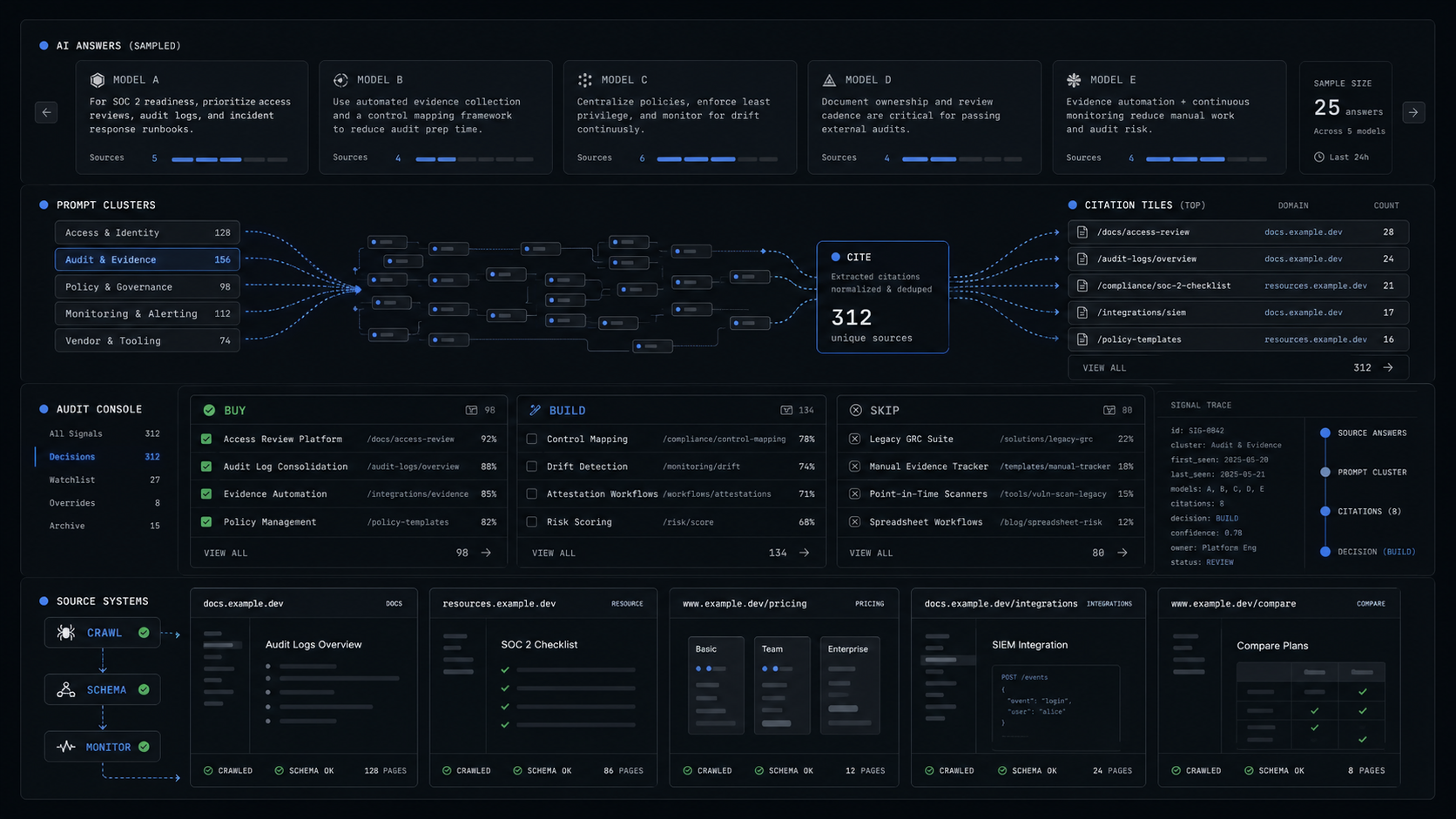
Use the paid tool to track mentions, citations, competitors, sentiment, and source gaps. Every dashboard issue should convert into a page fix, schema fix, or source claim update.
Review monthly, not randomly
Keep a monthly prompt set, compare changes, and document which pages were updated. AI visibility work dies when every week creates a new prompt set and no one owns the fixes.
This is the product-site work behind AI-search-ready product-site builds. The tracker is useful because it measures the gap. The site wins because it gives AI systems a better source to cite.
The Budget Rule
Start at the smallest tool tier that can produce a decision. Do not start at the tier that looks impressive in a board deck.
For a founder-led SaaS team, the first month can be one of three paths:
- Manual baseline plus Semrush's free checker if the site is still thin.
- OtterlyAI Lite at $29 per month if 15 prompts are enough to watch core buyer questions.
- Peec Starter at $95 per month if 50 prompts, 3 models, daily tracking, and unlimited users fit the team better.
For a marketing team with active SEO operations, the starting point is usually SE Ranking Core at $129 per month, or $103.20 per month when billed annually. The reason is not only GEO. It is the combined operating surface: 10 projects, 2,000 keywords, 100 prompts tracked daily, 5 domains in GEO research, 250,000 audit pages per month, 25,000 API credits, and MCP access.
For a brand or enterprise team, Scrunch Core at $250 per month can be a cleaner first paid benchmark than stitching together manual checks. Move to Enterprise, Profound Enterprise, or a larger Peec/Otterly tier only when the reporting load, model coverage, security controls, and integrations justify it.
The budget mistake is buying three overlapping products:
- A content optimizer because "AI SEO" sounds useful.
- A visibility tracker because competitors are talking about GEO.
- An SEO suite because the team already knows the brand.
That stack can easily cross several hundred dollars per month before anyone fixes the pages. The better sequence is one tracker, one owner, one prompt set, and a product-site backlog.
What To Skip
Skip tools that cannot show prompt history, citation sources, competitor mentions, and the exact pages that need work. A score without the source path is not operational.
Skip "AI SEO" subscriptions that only rewrite content. Content quality matters, but AI answer visibility is not a writing-grade problem alone. It is also crawl access, source quality, entity clarity, comparison coverage, and evidence freshness.
Skip broad dashboards before you name the owner. AI visibility work crosses marketing, product, docs, support, and engineering. If no one can change robots.txt, add schema, update pricing pages, or publish comparison pages, the dashboard becomes theater.
Skip a separate tool if your existing suite already covers the job. A team already using Semrush may not need another tracker until it has tested Semrush AI Visibility and the free AI Search Visibility Checker. A team already using SE Ranking for SEO may get enough GEO tracking inside Core or Growth. A team already using Surfer for content may use its AI Visibility tracking to guide content operations, while still treating crawl and evidence work as a separate build task.
The strongest stack is boring: one visibility tool, clear crawler policy, inspectable schema, source pages for the prompts that matter, and a monthly correction log.
FAQ
What are the best AI search optimization tools?
The best tool depends on the job. Use Scrunch or Profound for enterprise visibility operations, Peec or OtterlyAI for focused prompt tracking, SE Ranking for SEO plus GEO, Surfer for content workflow plus AI visibility, and Semrush AI Visibility if your team already runs Semrush.
What are AI SEO tools?
AI SEO tools now split into content optimizers, AI answer visibility trackers, and research assistants. A buyer should not treat those as the same category because each one solves a different part of the stack.
Can ChatGPT do SEO?
ChatGPT can help research questions, inspect pages, draft schema examples, and pressure-test copy, but it is not a visibility tracker. It does not replace prompt history, citation monitoring, crawler access, source pages, or structured product evidence.
Is SEO dead or evolving in 2026?
SEO is evolving into three connected motions: traditional search visibility, AI answer visibility, and product evidence architecture. The buyer still needs pages that can be crawled, understood, trusted, and cited.
Are free AI search optimization tools enough?
Free checks are enough for a first audit or a small manual baseline. Recurring visibility work needs a fixed prompt set, history, competitor tracking, source review, and a person accountable for implementing fixes.
Audit Your AI Stack
Find the AI search, SEO, and SaaS tools worth keeping before another monthly platform joins the stack.
Jun 23, 2026