Best Vibe Coding Platform for a Funded MVP
Compare Lovable, Bolt, Replit, and Cursor by price, ownership, handoff risk, and when a funded MVP needs scoped production work.

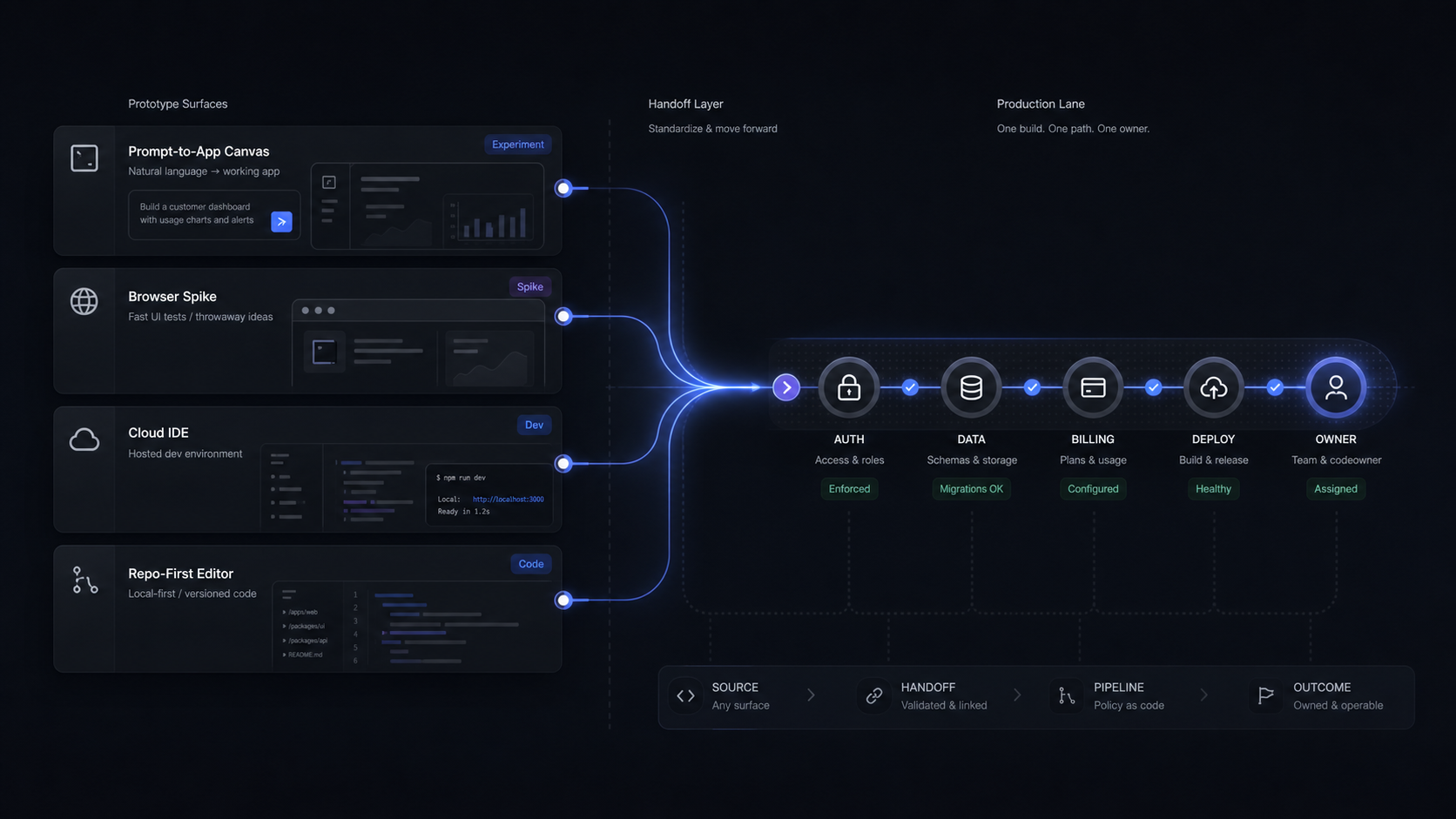
The best vibe coding platform for a funded MVP is the one you can hand off without losing control: Lovable for fastest founder-led web prototypes, Bolt for fast browser experiments, Replit when you need a hosted coding workspace, and Cursor when a developer will own the repo. If real users, payments, permissions, or diligence matter, the platform is the start of the build decision, not the whole build.
The Short Verdict
Choose the platform by the person who will own the next month of work. A non-technical founder who needs a clickable SaaS flow should start in Lovable. A founder testing a narrow browser-based idea can use Bolt. A technical founder who wants a cloud workspace, deploys, agents, and database support in one place should use Replit. A developer or senior studio should use Cursor when the work belongs in a normal repo with review discipline.
That is the difference between a demo and an MVP. Vibe coding means describing what you want and iterating on AI-generated software, but a funded MVP still needs one core workflow, reliable auth, data rules, payments when revenue is part of the test, production deployment, and code ownership. The winner is not the tool that makes the prettiest first screen. It is the tool that creates the least expensive path from learning to owned software.
Use this rule:
- Lovable when the fastest useful artifact is a founder-operated web app or investor demo.
- Bolt when the scope is a quick spike, a simple app shell, or a browser-only experiment.
- Replit when the build needs a hosted coding environment and a technical operator can inspect what is happening.
- Cursor when the MVP belongs in a repo from day one and a developer will keep the product moving.
- A scoped studio build when the prototype must become a product with users, roles, billing, integrations, analytics, and handoff.
Use a dedicated hardening plan once the prototype proves the workflow. The rewrite-debt handoff checklist is the next step when a vibe-coded app starts collecting real users or money.
The Comparison That Matters for a Funded MVP
The production question is not "which platform can create an app?" The production question is "what do you own when the demo becomes important?" Price matters, but ownership, collaboration, deploy path, usage limits, and review control matter more.


The expensive mistake is picking by first-demo speed when the business actually needs handoff certainty. A funded founder usually has two jobs: learn fast enough to avoid building the wrong thing, then create a version that a team, investor, buyer, or technical lead can inspect. Vibe coding helps with the first job. It only helps with the second job if the code, data model, environment variables, auth rules, payment states, and deployment process are made explicit.
This is why a broad AI app builder comparison is not enough for a funded MVP decision. The buyer question is narrower: which tool leaves you with the fewest hidden liabilities after the demo works?
Lovable: Best When the Founder Needs a Web App Prototype Fast
Lovable is the strongest first move for a non-technical founder who needs a real-feeling web app quickly. Its docs describe a natural-language builder that generates a working application with frontend, backend, database, authentication, and integrations, backed by editable code. They also state that projects can sync to GitHub and that users keep full ownership of their code.
The current pricing makes it easy to start. Lovable Free is $0 per month and includes credit grants to build and run the app on Lovable, workspace-private projects, unlimited collaborators, 5 lovable.app domains, and Cloud. Pro is $25 per month with 100 credits per month, credit rollovers, on-demand credit top-ups, unlimited lovable.app domains, custom domains, and badge removal. Business is $50 per month with 100 credits per month, team workspace, role-based access, internal publish, personal projects, SSO, a security center, and design templates. Enterprise is custom and adds volume-based credit pricing, dedicated support, onboarding services, sharing controls, and audit logs.
Use Lovable when the first useful question is "can users understand and complete this workflow?" A funded founder testing an onboarding, dashboard, or customer portal can get farther with Lovable than with static mockups because the prototype can carry screens, data shape, auth flow, and basic integrations in one place.
Scope the Lovable prototype as one workflow
Write the build brief around one user and one outcome: for example, "a team admin invites a client, the client uploads a file, the app returns a reviewed status, and the admin can approve or reject it."
Separate demo polish from product truth
Use Lovable to make the flow understandable, but log every hidden product decision: roles, data retention, permissions, error states, emails, billing status, and who can see each record.
Use GitHub sync as a handoff gate
Do not wait until the prototype is large. Sync early, inspect the repo, and confirm a technical owner can run, review, and change the app outside the prompt loop.
Stop when the workflow is proven
Once users can complete the core flow, move to scoped hardening instead of prompting another set of features into the same prototype.
Lovable becomes risky when the founder keeps adding edge cases without a technical review loop. The first version should prove demand, not absorb every enterprise feature. For a funded MVP, the right Lovable endpoint is a clear handoff package: working flow, repo, auth assumptions, data model, integration list, known gaps, and the features that deliberately stay out of v1.
Bolt: Best When the Job Is a Browser-Based Spike
Bolt is best when speed matters more than long-term structure. Its current Free plan is $0 and includes public and private projects, a 300K token daily limit, 1M tokens per month, Bolt branding on websites, a 10MB file upload limit, website hosting, up to 333k web requests, and unlimited databases. Pro is $25 per month billed monthly, removes the daily token limit, starts at 10M tokens per month, removes Bolt branding, adds private sharing, a 100MB file upload limit, custom domain support, SEO boosting, expanded database capacity, choice of database provider, and image editing with AI. Teams is $30 per month per member and adds centralized billing, team-level access management, granular admin controls, user provisioning, organization sharing, private NPM registries, and design system knowledge with per-package prompts.
Those limits define the right use case. Bolt is a strong place to test an interface idea, an onboarding path, a lightweight portal, or a throwaway internal workflow. It is less attractive when the important work is architecture, compliance, unusual integrations, or a codebase that another team must maintain for months.
The practical issue is context. Bolt's own pricing explains that most token usage is related to syncing the project's file system to the AI, and larger projects use more tokens per message. That is not a failure, it is the shape of the tool. When the project grows, each prompt carries more surrounding code and the cost of change rises.
Use Bolt when the project brief fits on one page:
- A single role or two clearly separated roles.
- One primary data object.
- One success path.
- No custom billing logic.
- No sensitive workflow where an incorrect permission check creates real risk.
- A clear plan to discard, rebuild, or transfer the useful parts after validation.
Bolt is the right answer for "show me the thing by Friday." It is the wrong answer for "keep extending this until it becomes the company." Funded teams should treat Bolt output as a prototype asset unless a developer has reviewed the repo, deployment setup, data model, and security boundaries.
Replit: Best When the Prototype Needs a Hosted Coding Workspace
Replit is the best fit when the founder or early team wants a coding environment, not just a prompt-to-app canvas. The current Starter plan is free and includes free daily Agent credits, a built-in database for full-stack apps, the ability to publish up to 1 project, and private or password-protected deployments. Core is $20 per month monthly or $18 per month billed annually, with $20 monthly credits, up to 5 collaborators, up to 2 parallel agents, regional publishing, and unlimited workspaces. Pro is $100 per month monthly or $90 per month billed annually, with $100 monthly credits, up to 15 collaborators, up to 50 viewers, up to 10 parallel agents, access to the most powerful models, database rollbacks for up to 28 days, and premium support. Enterprise is custom and adds custom seat limits, SSO/SAML, advanced privacy controls, and VPC peering.
Replit is useful for a technical founder because the workspace, agents, database, deployment, collaborators, and credits are visible in one environment. That makes it easier to move from "the AI generated something" to "we can inspect and operate this." It also makes Replit a better choice than a pure prompt-to-app surface when the MVP needs scripts, background jobs, API integrations, or a developer who wants to see the moving parts.
The production warning is also explicit: Replit says its Agent is powered by large language models and may occasionally make mistakes. That should shape your process. Agent output needs review, test data, environment separation, and a handoff checklist before it carries customer data.
Replit is the middle path: more inspectable than a pure visual AI builder, lighter than a fully local engineering setup. It wins when a technical operator will own the next iteration. It loses when nobody on the team can review what the agents create.
Cursor: Best When a Developer Will Own the Repo
Cursor is the best vibe coding platform only if "platform" means an AI-native coding environment for people who work in code. Hobby is free with limited Agent requests and limited Tab completions. Individual is $20 per month and adds extended limits on Agent, frontier models, MCPs, skills, hooks, cloud agents, and Bugbot on usage-based billing. Teams is $40 per user per month and adds centralized billing and administration, a team marketplace for internal rules, skills, and plugins, agentic code reviews with Bugbot, cloud agents and automations with shared team context, usage analytics, team-wide privacy mode, and SAML/OIDC SSO. Enterprise is custom with pooled usage, invoice or PO billing, SCIM seat management, repository, model, and MCP access controls, plus priority support and account management.
Cursor does not solve the non-technical founder's blank-page problem in the same way Lovable does. It solves a different problem: a developer needs to move faster inside a real repo. That makes it the right choice when the codebase already matters, when architecture has to be reviewed, or when the MVP is too specific for a prompt-to-app platform to own safely.
The control story is stronger for teams. Cursor's pricing page says privacy mode can be enabled in settings or by a team admin, and when it is enabled, code data is not used for training by Cursor or model providers. For a funded SaaS team, that matters. So do usage analytics, team administration, cloud agents with shared context, and access controls in Enterprise.
The tradeoff is that Cursor assumes an engineering owner. A founder can use it with enough technical fluency, but it will not rescue an unclear scope. It amplifies product engineering judgment. If the judgment is missing, the tool only makes more code faster.
Use Cursor when the MVP brief already has:
- A repo owner.
- A framework choice.
- Auth and data rules.
- Payment state definitions.
- Review and deploy gates.
- A plan for tests, logs, errors, and production access.
If those are missing, start with a prototype tool or a scoping sprint before writing more code.
The Handoff Rule
The safest path is to let vibe coding answer the learning question, then switch to scoped production work before the prototype becomes load-bearing. Load-bearing means real users depend on it, customer data lives in it, payments move through it, or investors and buyers are judging the product from it.
A funded MVP should pass six handoff checks:
- Repo ownership: the code can be exported, run, reviewed, and changed outside the original prompt session.
- Auth clarity: roles, invites, sessions, password reset, and account deletion are defined.
- Data clarity: each table or collection has an owner, retention rule, and permission rule.
- Billing clarity: Stripe states, plan limits, failed payments, invoices, and webhooks are scoped or deliberately excluded.
- Deployment clarity: environments, secrets, domains, logs, backups, and rollback are documented.
- Scope clarity: v1 has one core workflow, not a backlog disguised as a product.
The handoff point is where a scoped studio build often becomes cheaper than more prompting. A senior team can keep the useful discovery, cut the speculative features, harden the one workflow that matters, and ship a launch-ready version with code ownership from day one.
FAQ
Is vibe coding actually worth it?
Yes, when the goal is fast learning. It is worth it for prototypes, founder demos, internal tools, and early workflow validation. It stops being enough when the app needs production auth, permissions, billing, support paths, and code handoff.
Is vibe coding a trap?
It is a trap only when the prototype is treated as a finished product. The safer pattern is prototype, test, document what worked, then harden or rebuild the proven workflow with explicit ownership.
What is the best vibe coding platform for beginners?
Lovable is the safest beginner default for a web app because it creates a full app experience from natural language and supports GitHub sync for handoff. Bolt is better for a quick browser experiment. Replit is better when the beginner has some technical confidence.
Is ChatGPT or Claude better for vibe coding?
The environment matters more than the model. A prompt-to-app platform is better for a non-technical founder who needs a visible workflow. An IDE agent is better when a developer needs repo control, tests, and review gates.
Can a vibe-coded MVP raise money?
It can support fundraising if it proves the workflow clearly, but it should not pretend to be production-ready unless the code, data, auth, deploy, and handoff work have been reviewed. A strong demo helps the story; a fragile product creates diligence risk.
Book the Scoping Sprint
Turn the prototype into a fixed-scope MVP plan with the core workflow, handoff, build path, and cut list defined before production work starts.
Jun 30, 2026