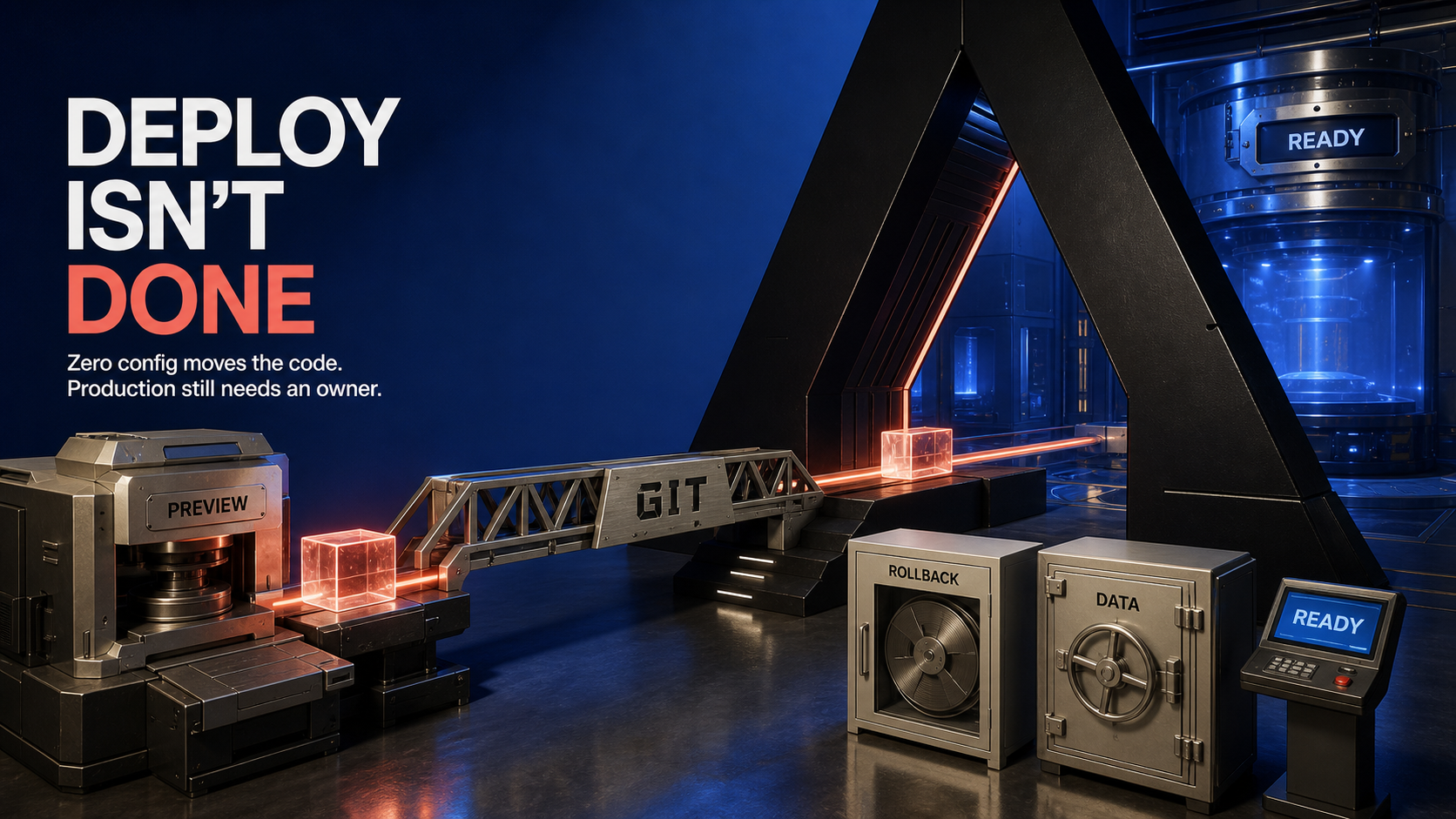
The OpenAI Presence Readiness Test for Production Agents
OpenAI Presence is managed enterprise deployment, not self-serve. Use its controls as a practical go-live test for your first production agent.


OpenAI Presence is an operating model for production agents, not a self-serve shortcut. Most funded startups should not plan around buying it today; they should use its policy, evaluation, escalation, and rollback controls as a go-live test.
Copy the operating model before you buy the product
Most startups should copy Presence's controls before they consider Presence itself. OpenAI announced OpenAI Presence on July 22, 2026, and the product boundary matters more than the launch language.
OpenAI Presence is a managed enterprise platform for building, deploying, operating, and continuously improving governed AI agents for high-volume, high-stakes workflows. A governed agent is one whose permissions, policies, tests, and change process are explicit. A production agent is one that serves users or staff inside a live workflow, often with access to company systems.

Presence is currently available through limited general availability as a managed deployment. Limited general availability means a controlled release to eligible customers. Presence is not a self-serve product. Access depends on workflow fit, implementation readiness, and available delivery capacity. Pricing and implementation scope are specific to each customer and deployment.
Consider an illustrative seed-stage billing agent. It reads an invoice status, drafts an answer, and sends refund requests to a person for approval. That company does not need an enterprise-wide agent platform decision yet. It needs one bounded job, narrow system permissions, a written refund policy, failure tests, and a safe release path.
That is the useful signal in the launch: the operating work is part of the product.
The readiness test is four gates, not a demo score
Your agent is ready only when it passes four gates: Scope, Control, Prove, Operate. A convincing conversation proves that a model can respond. These gates prove that a company can be responsible for what happens next.

Scope: give the agent one job
Scope passes when the agent has one named outcome and a clear stop condition. Each Presence deployment starts with a specific job. The same rule keeps a startup build small enough to evaluate.
For the billing example, the job is not "handle customer support." It is: answer invoice-status questions from approved account data, then prepare a refund request when the written policy permits one. Account cancellation, contract changes, and custom discounts stay out of the first release.
The scope artifact should name the user, trigger, allowed data, allowed action, successful outcome, and escalation condition in one page. If two stakeholders describe different jobs, the build is not scoped.
Control: separate reading, proposing, and acting
Control passes when every system permission has a business reason and every consequential action has an owner. A Presence agent can use approved knowledge and connect to business systems through APIs and tools with scoped permissions. A Presence agent can retrieve information, update systems, and complete approved actions. It can also escalate to a person or another support path when a policy, risk, or workflow requires human judgment.
For the billing agent, split the work deliberately:
- Reading invoice and plan data can be automatic for an authenticated account.
- Drafting a policy-grounded answer can be automatic.
- Creating a refund request can be automatic.
- Approving and issuing that refund stays with a person until evidence supports a narrower approval rule.
This is not a model setting. It is a product decision about authority.
Prove: test outcomes, policy, tools, and escalation
Proof passes when the same acceptance set can grade every release. Presence governance can include simulations and evaluations for common workflows and edge cases before release. It can also include guardrails, permissions, and approval steps that define what the agent can do.
Use the billing policy as an executable test set:
Write the expected outcome
Create cases for an allowed request, a denied request, missing identity evidence, unavailable billing data, ambiguous intent, and a request outside policy. Record the correct answer, tool action, and escalation for each.
Grade the whole workflow
Check whether the agent reached the right outcome, followed policy, used the correct tool, and escalated with useful context. A polished sentence does not compensate for the wrong action.
Make failure block release
Set acceptance criteria before testing. If a policy or permission case fails, the release stays blocked even when the average response quality looks good.
Operate: release with evidence and rollback
Operate passes when you can see what happened, limit exposure, and restore the previous version. Presence governance can include session records, action histories, and quality signals that teams review to improve the agent. Presence governance can include controlled rollout, monitoring, and rollback processes for new versions.
Release the billing agent to internal staff, then invited accounts, then wider traffic only after the evidence holds. Log the policy version, tool call, approval state, final action, escalation reason, and agent version for every consequential session. Define the rollback trigger and owner before traffic arrives.
A launch without those records is not a controlled experiment. It is an unmeasured policy change.
Choose managed deployment or a smaller owned build
Choose Presence only when managed deployment is part of the requirement. Presence supports conversational workflows through voice or chat during limited general availability. It is designed for organizations with repeatable workflows that need strong governance, reliability, and operational oversight.
Explore Presence when you are an eligible enterprise customer, the workflow is high-volume or high-stakes, and you need OpenAI or a selected deployment partner involved in technical scoping, review, rollout, and ongoing improvement.
Build a smaller owned agent when you have one bounded workflow, need to learn with a controlled user group, and can own the policy, evaluation set, logs, approvals, and rollback path. OpenAI says it will continue supporting voice customers with access to frontier models through the OpenAI API. The decision is not "enterprise platform or nothing."
Do not treat Presence and ChatGPT Workspace Agents as two tiers of the same product. OpenAI Presence is a separate managed enterprise product from ChatGPT Workspace Agents. Presence agents are scoped and deployed with OpenAI, a select deployment partner, or both and are not created through the ChatGPT workspace agent interface.
For budget planning, separate model usage from the operating work around it. Our guide to AI agent pricing models shows why seats, credits, and completed work produce different cost questions. Presence adds a managed-deployment decision on top of that model.
The improvement loop is the product
The evidence loop, not the first model response, is the control that keeps an agent useful after launch. After launch, production sessions and escalations reveal gaps; Codex proposes updates that teams can test and approve. Teams can test each proposed change against the version in production, then approve a controlled rollout.
OpenAI reports that Presence now resolves 75% of inbound issues on its English-language phone support channel without human assistance. OpenAI reports that its Codex-powered improvement loop reduced human handoffs by 15 percentage points in 10 days. Those are OpenAI's results on its own channel, not an independent benchmark or a promised outcome for another deployment.

The transferable lesson is the loop. Suppose the billing policy changes and a refund now needs a different approval path. Production sessions expose the mismatch. The team classifies the failure, changes the policy or tool logic, replays the acceptance set, compares the candidate with the live version, and approves a limited rollout. If the evidence degrades, rollback is already defined.
A startup can copy that process without copying the enterprise deployment. The decisive control is simple: no agent change reaches wider traffic until it beats the current version on the same acceptance set.
Hand this production-agent scope to your build team
The best first scope is six deliverables, not a feature wish list. OpenAI describes a six-stage managed deployment process: define outcomes and workflows; connect systems and encode policies, permissions, and escalations; complete security, privacy, and legal review; run simulations, evaluations, and acceptance testing; stage a controlled rollout and monitor outcomes; review evidence and make tested improvements.
Translate that process into a fixed scope:
Outcome and workflow
Name one user, one trigger, one outcome, and the cases the agent must refuse or escalate. For billing support, success is a correct invoice answer or a complete escalation, not a long conversation.
Systems and authority
List each data source and action separately. Mark it read, propose, approve, or execute. Give the agent the narrowest permission that completes the job.
Policy and escalation
Turn the operating policy into explicit decisions. Name who receives an escalation, what context arrives with it, and what the agent tells the user while a person takes over.
Security and data review
Document what data the agent can access, what is logged, what must be masked, how long records remain, where they are stored, and which roles can inspect them. Do this before connecting production accounts.
Evaluation and acceptance
Build the acceptance set from common requests, edge cases, policy boundaries, tool failures, and unsafe requests. Tie release approval to outcomes and actions, not tone alone.
Rollout and improvement
Choose the first controlled audience, the health signals, the rollback trigger, the review owner, and the change-approval path. Keep the prior version recoverable while the new one proves itself.
This scope also makes the build easier to price. A fixed price can cover the workflow, integrations, control layer, acceptance set, monitored release, and handover because the boundary is visible. "An agent that handles support" cannot be priced honestly because the job, authority, and acceptance condition are missing.
If the underlying product was assembled quickly, use the same evidence standard as our production launch test: ownership and rollback come before feature breadth.
What Presence still leaves to scoping
Presence does not eliminate the decisions that make procurement safe. Exact features, models, channels, capacity, data handling, pricing, and service commitments are defined for each deployment. The available channel, contact-center integration, routing, authentication, and human-handoff design are confirmed for each deployment.
Data handling is defined and reviewed for each deployment, including data access, logging, masking, retention, storage location, and access control. Put those fields in the statement of work, the contract that fixes scope, acceptance, ownership, and delivery obligations.
For a founder evaluating Presence, ask for the configured answer to each field rather than a generic capability claim. For a founder building a smaller agent, make the same decisions in the product scope. The platform choice changes who helps deliver the controls. It does not make the controls optional.
OpenAI Presence FAQ
Is OpenAI Presence self-serve?
No. Presence is not a self-serve product. It is available to eligible enterprise customers through limited general availability as a managed deployment.
Which channels does OpenAI Presence support?
Presence supports conversational workflows through voice or chat during limited general availability. The exact channel, integration, routing, authentication, and human-handoff design are confirmed for each deployment.
How is OpenAI Presence different from ChatGPT Workspace Agents?
OpenAI Presence is a separate managed enterprise product from ChatGPT Workspace Agents. Presence is scoped and deployed with OpenAI, a selected deployment partner, or both rather than created through the ChatGPT workspace agent interface.
How do I get access to OpenAI Presence?
Access goes through an OpenAI account team and depends on workflow fit, implementation readiness, and available delivery capacity. Pricing and implementation scope are specific to each customer and deployment.
Scope Your MVP Sprint
Turn one agent workflow into a fixed-price production scope with controls, evaluations, and a launch site included.
Jul 26, 2026